
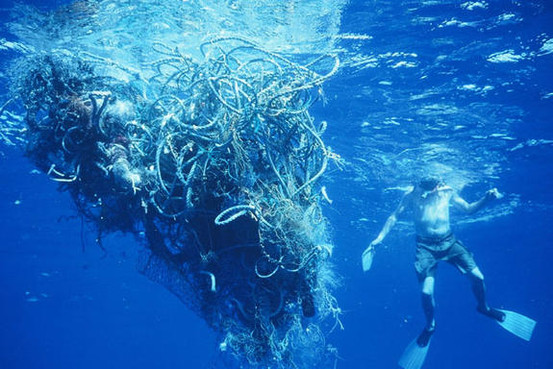

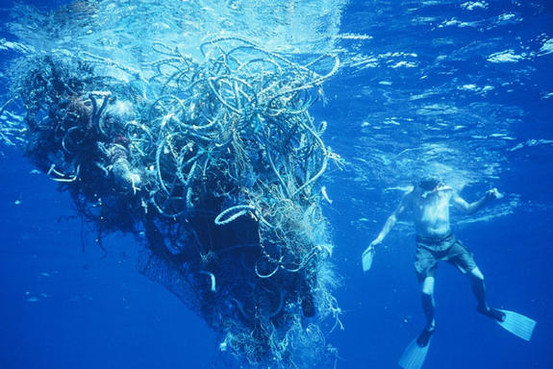
Brazilian naval personnel were astonished to discover that what they thought to be remains of the missing Air France flight 447 in the Atlantic Ocean turned out to be nothing more than garbage and other debris located at or near the surface of water.
Even the supposed oil slick that they thought came from the missing plane has now been attributed to being bilge oil from a passing ocean vessel. And what was thought to be pieces of the plan’s fuselage turned out to the pieces of plastic as well as a wooden pallet!
Smaller marine bodies of water are at even greater risk; especially ones like the Mediterranean, said to be one of the most polluted bodies of sea water, as well as the Persian Gulf.
The Mediterranean has been suffering from wholesale pollution for years, and from a number of sources, including garbage (especially plastic items), raw sewage (much of it from cruise ships and military vessels) and industrial wastes from cities like Haifa, Beirut, Trieste, and many others.
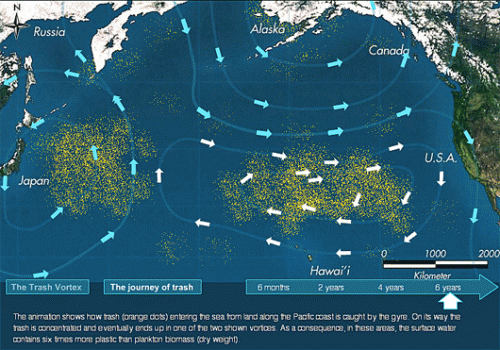
Oceanographers have been studying for years the disturbing effects of floating garbage on the world’s seas and oceans; and one extremely large patch of floating debris, in the mid-Pacific Ocean, is estimated to be twice the American state of Texas.
The large patches of floating plastic material, waste oil (also from damaged supertankers) and other material are said to form in parts of the ocean known as gyres and are formed between a strong and narrow “western boundary current,” and a weak and broad “eastern boundary current.
Gyres are found in all the world’s ocean; and include the Arctic and Antarctic oceans as well. Although the suspected crash site of Flight 447 appears to be south of the North Atlantic Gyre, it doesn’t mean that aquatic debris isn’t located there; it most certainly is.
Besides being a food source for the world’s populations the world’s oceans are also a supplier of a good portion of our oxygen supply which is produced by aquatic plant life – especially kelp.
The “floating garbage dumps” are a big hazard for marine life, including birds which often feed their young small pieces of plastic that the birds think is food. In addition, all kinds of chemicals, sewage and poisons are present in the waters which eventually can be dangerous to animal and human health.
The bottoms of our seas and oceans are as bad or worse, and some areas have even been declared as “dead zones” are virtually devoid of marine plant and animal life. Most people don’t thing much of this problem, unless they are swimming of diving somewhere and find this garbage themselves. The problem will also manifest itself when less fish are caught, and those that are discovered will be unfit to eat.
The Persian Gulf is in a very precarious situation as it is still trying to recover itself from the disaster of the 1991 Gulf War (when millions of gallons of crude oil was dumped into the Gulf by Saddam Hussein’s army) as well as the intense development programs by countries which share its shoreline; including Kuwait, Saudi Arabia, the UAE, and Iran.
While Emirate states like Dubai and Qatar are spending billions to construct futuristic cities resembling something out of a science fiction novel (see their latest vertical farm at sea), are they doing their share to help preserve the ecosystem of this body of water? It appears they could do a lot more than just construct fantastic buildings and artificial islands like Palm Island.
Undoubtedly the Flight 447’s wreckage will be found sooner or later; but at least for now, people may begin to see how Mankind has literally “trashed” the world’s seas and oceans.
[top image via hd2o.tv]
More on plastic and water:




[…] than ten years ago, when Ian Kiernan took a solo sailing trip around the world, he discovered the trash filling up our oceans and decided to make a change. Today, 35 million people in 120 countries are doing the same. Kiernan […]
[…] the world’s human inhabitants. This increasing problem was also brought to light during the search operation for the missing Air France Flight 447 in June, […]
[…] Read more articles on pollution and chemical impacts on fish and marine life: Hunt for Air France Flight 447 Brings Marine Garbage Problem to The Surface […]
Great! Thank for information, I'm looking for it for a long time,
Great! Thank for information, I'm looking for it for a long time,
I’ve been following the news, and it appears that the Brazillian naval and air forces have begun to find items attributed to Flight 447, including two bodies. But there’s a lot of ocean to search in, as these were found about 660 miles off the Brazilian coast. As far as photos of the areas of floating garbage, satellite photos are inconclusive and a lot of this trash is clear plastic bags and other material that can’t be picked up in satellite photos. But ships passing by have seen the trash first hand.
Here you can find an amazing series of videos about these Garbage Islands http://tinyurl.com/op769p
Like no one knew there was garbage in the ocean before the jet disappearance?
Hunt for Air France Flight 447 Brings Garbage Problem to the Surface http://tinyurl.com/ooa4ux #waste http://tinyurl.com/op769p
RT @kloostermania: The vortex of garbage that surfaced during hunt for Air France survivors: http://bit.ly/g2BWR
The vortex of garbage that surfaced during hunt for Air France survivors: http://bit.ly/g2BWR
Are there photos or more evidence of this 2 times the state of texas garbage pile in the pacific?
Naval personnel thought they found more bodies from the Air France wreckage, but it’s floating garbage dumps: http://tiny.cc/ugnG8.
Even most French people no longer bring their baguettes and other things home in wicker baskets. It’s usually brought in plastic bags, many of which end up in those floating garbage piles.
Hunt for Air France Flight 447 Brings Garbage Problem to the Surface http://ow.ly/cHDG
Amazing,
I knew dumping from ships was a problem, but I was unaware of how bad the sitution was. It reminds me of the floating satellite garbage that encircles the earth. It’s sad to think that one day our seas and skies could be primarily floating piles of garbage.