

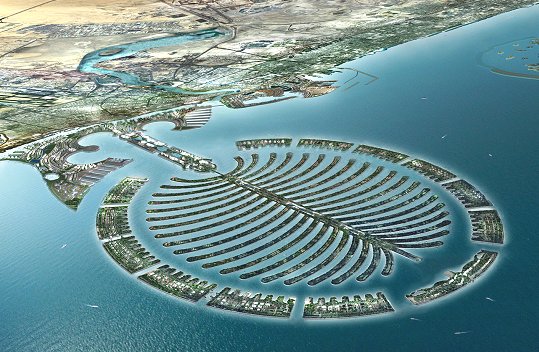
(Palm Island in Dubai)
A couple of weeks ago I was in New Orleans with my parents at the annual craziness known as Fat Tuesday during Mardi Gras. Besides the excess of everything I saw there including waste, and the nasty black eye I sustained from a large set of beads being thrown on my head off a Bourbon Street balcony (my friend warned that the beads always come with strings attached), I saw sections of the city that have not yet been rebuilt since Hurricane Katrina.
Like New Orleans which is built below sea level, the Dutch have been fighting nature for centuries, as have the Venetians. According to a new study by an Indian scientist, the mega-urban development projects (like the one pictured above) being established in the Middle East (United Arab Emirates (UAE), Qatar and Bahrain) are just setting people up to be victims of natural disasters. Things will look even worse once the effects of global warming become more pronounced, warn experts.
Apparently no environmental assessment of these developed regions was done before towns and cities were constructed in these unusual settings.
Artificial islands and offshore luxury townships coming up in the Persian Gulf are potentially vulnerable to natural hazards like earthquakes and tsunamis, cautions Arun Kumar, a professor at King Fahd University of Petroleum and Minerals in Dhahran, Saudi Arabia.
Although they are futuristic and novel, “there are serious issues of long-term sustainability of these townships,” he says in The Hindu.
“Natural hazards have struck this region in the past and have the potential to strike again any time in the future,” Kumar warns in a report published in the latest issue of Current Science.
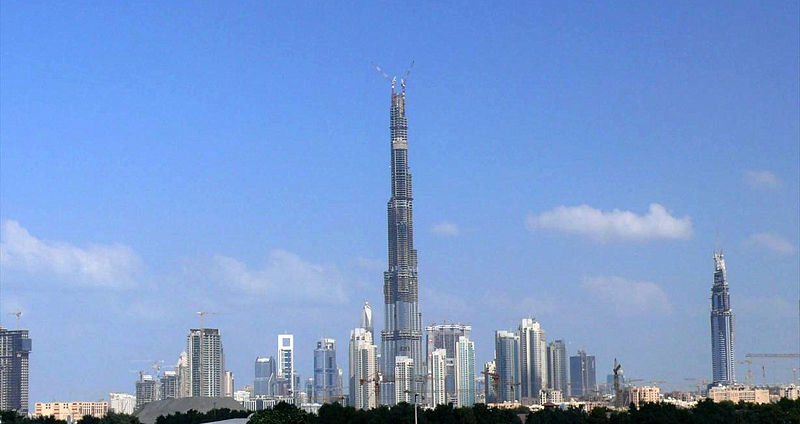
(Burj in Dubai)
According to the report, the massive development projects in the United Arab Emirates (UAE), Qatar and Bahrain are susceptible to both geological and atmospheric hazards.
For example, the city of Dubai is developing five new giant offshore island communities: The Palm Jebel Ali, The Palm Jumeirah, The Palm Deira, The World, and The Universe.
The Pearl Qatar is another colossal project being developed by Qatar on reclaimed land. Bahrain is also developing similar urban projects.
Natural hazards risk
According to the scientists, tropical cyclones and the resulting oceanic surges are the main possible atmospheric hazards that can strike this region at any time in the future.
His report warns about the likelihood and possible impact of each of these unsafe events. With global warming in mind, there is also the issue of the long-term supply of potable water to such communities.
“The danger of earthquakes would be higher in reclaimed islands and their tall buildings because reclaimed land is potentially more susceptible to liquefaction and slope failure,” the report warns. Liquefaction is a phenomenon where soils suddenly go from a solid state to a liquefied state that can happen when the ground is shaken during an earthquake.
Other natural disasters that could strike the Gulf:
- Tropical cyclones are becoming more frequent due to the effects of global warming.
- Inundation and erosion due to a rise in sea-level and an increase in storm surge events.
- Movement of surface and submarine currents in the Gulf poses a severe threat of erosion to these man-made islands.
- Evironmental pollution and algal blooms due to eutrophication within the closed water bodies due to lack of circulation, absence of currents and surface waves, and heavy input of organic waste are expected to be serious issues.
“I am not sure if environmental impact assessment was done for these reclaimed islands,” Kumar said. “May be they did such studies but I did not find any information in the public domain.”
:: The Hindu



[…] caused by the palm islands development? Well I think we can probably expect more of those ill-thought projects. According to an article in the FT, plans to build this underwater hotel are a “sign that the […]
[…] caused by the palm islands development? Well I think we can probably expect more of those ill-thought projects. According to an article in the FT, plans to build this underwater hotel are a “sign that the […]
[…] sustainability and usefulness of Dubai’s artificial palm-shaped Island has been widely debated but I think a recent problem at one luxury complex has ironically helped […]
[…] sustainability and usefulness of Dubai’s artificial palm-shaped Island has been widely debated but I think a recent problem at one luxury complex has ironically helped […]
[…] to imagine. Libyans are experiencing untold suffering as one man struggles to hold on to power, and natural disasters are taking an increasingly high toll everywhere. To understand such seeming senselessness, human […]
[…] apartment. Residents similarly pay a handsome sum to live at one of Dubai’s much-touted artificial palm islands. Within the last few years, despite warnings from environmentalists, people flocked to snatch a […]
[…] Gulf Island Projects are an Environmental Disaster Waiting to Happen AKPC_IDS += "20239,";Browse topics: Abu Dhabi, animal conservation, Persian Gulf […]
[…] in the region, hugely capital-intensive projects like the Palm Islands (in Dubai), Masdar City (Abu Dhabi), Cedar Islands (Lebanon) and Burj Khalifa (Dubai) earthworks that are […]
[…] doesn't take a whole lot of common sense to figure this one out: you build monolithic structures and artificial islands on a fragile seashore along the Persian Gulf, have oil tankers pulling petrochemicals from the land which leaks into the water. Add a little […]
[…] doesn't take a whole lot of common sense to figure this one out: you build monolithic structures and artificial islands on a fragile seashore along the Persian Gulf, have oil tankers pulling petrochemicals from the land which leaks into the water. Add a little […]
[…] The Gulf’s artificial islands are a disaster waiting to happen. When faced with a tsunami, or another natural disaster, it could be bye-bye to people and the […]
Now I REMEMBER why I'm NOT attracted to DUBAI when I was there for IDEX – it reminded me of the FORBIDDEN City in Yemen http://bit.ly/64DOJK
Mega Urban Developments In Gulf Region A Natural Disaster Waiting to Happen http://tinyurl.com/dn5t6m