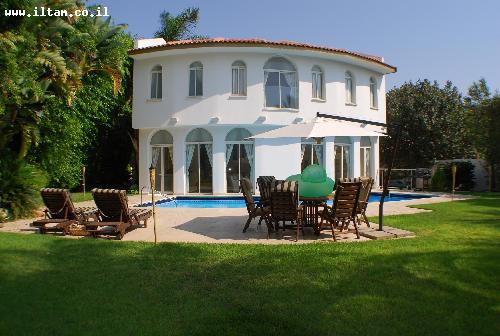
If you’ve heard about the demise of the kibbutz movement, then you may also know that financially strapped communal farms have recently climbed out of debt by building suburban-style detached housing developments and selling them to upwardly mobile Israelis.
Suburbanizing kibbutzim and moshavim (village settlements), along with several new suburban-style towns like Shoham (near Ben Gurion Airport), Kochav Yair (on the West Bank border in the country’s center) and Maccabim-Re’ut (between Jerusalem and Tel Aviv) are transforming the Israeli landscape from what used to be small villages surrounded by agricultural fields towards American conceptions of large, well-appointed homes in neighborhoods dependent on cars.
One of the best looks at the roots of this revolution is Amiram Gonen’s 1995 book ‘Between City and Suburb’, an extensive academic take on the changing forms of Israeli communities.
Gonen, a professor of geography, begins with traditional Israeli perceptions of the city and the countryside. In the state’s first few decades, urban cores were sites of prestige, while low-quality housing estates and shabby development towns grew on the fringes of the cities and in the country’s periphery. Gonen says part of this was because of how late Israeli cities industrialized. While in the United States, the United Kingdom and other countries, factories made cities sooty and crowded, Industry only came to Israeli cities in the 1930s:
“The typical economic development that took place in the inner city was that of small-scale commerce and crafts, which can easily coexist with a residential population … a fact that kept the middle classes there for quite a while.”
Israeli workers enjoyed living near their place of employment, and often feared moving to the countryside where they might be vulnerable to attacks in the pre-state years. Moreover, many of the early Israelis were transplants from Europe; on the Continent the poor peasants lived in the countryside, while the bourgeoisie occupied the cities.
“In the recent past, the Israeli suburb was not associated with wealth, spaciousness, greenery and tranquility, as the term might often imply in the English language… the term in its Israeli context was associated with low income, low quality of life, poverty and remoteness.”
Shifts in Israeli consumer culture
However, Gonen shows that with time, Israelis grew to be more oriented to North American consumption patterns.
National car ownership rose, public transportation improved, and apartment dwellers started to dream about living in their own home with a private garden and a bedroom for each child.
As Israelis imagined “rurban,” or rural-urban, paradise in the 1990s, a million immigrants arrived from the Former Soviet Union, straining the housing capacity of the cities. In response, the government released thousands of acres of protected farmland and allowed residential building on what used to be the fields of communal farms.
However, rather than put up immigrant housing blocks as had been done in the past, the government left the construction to private developers, who maximized the value of the land lots by building single-family homes. Gonen writes that as a result of farmland privatization, “urban Israel is on the threshold of decontainment, each moshav and kibbutz near a city searching for opportunities to reap the economic fruits of this policy shift.”
This decontainment holds particularly dire consequences for the racial mix of the country, because it allows the primarily Ashkenazi upper-middle class to move to economically exclusive communities, which takes the lifeblood out of the cities and could lead to an American-style decline.
Gonen warns that “The city of Be’er Sheva, already undergoing a middle-class drain in the direction of new suburban towns established in its vicinity in recent decades, might continue to experience such a drain if adjacent agricultural settlements take the initiative to rezone their agricultural land and develop residential neighborhoods on it.”
In addition to tracking the birth of the suburban Israeli Dream, Gonen also dabbles in Ultra-Orthodox housing patterns, Arab urban planning and the ethnic gap between Israelis of Ashkenazi and Mizrachi extraction as seen through housing patterns.
As an environmentalist, I was disappointed with Gonen’s tepid reaction to Israeli suburbanization. I was gunning for a spirited condemnation, and found that his professorial tone stayed away from the rhetoric. However, this criticism is more of a complement, as Gonen keeps it professional although he discusses sensitive topics.
‘Between City and Suburb’ is a fascinating peek into how very personal dreams – the desire to own one’s home, the wish to live among fellow religiously observant Jews, the hope to move out of a development town – have shaped the form of the Israeli built landscape. A definite must-read for all of us concerned with the shifts in Israeli culture and how this impacts upon the environment.
‘Between City and Suburb – urban residential patterns and processes in Israel ‘
by Amiram Gonen, published 1995 by Avebury
This review was written by our very own Green Prophet Daniella Cheslow, a passionate environmentalist, activist, journalist and currently a master’s student at BGU. Her blog, The Truth Herzl, is packed full of her adventures, reviews, and more!