



Green Design – From Theory to Practice (see preview post here), a major international architectural seminar took place this week here in Jerusalem, bringing together leading experts from the worlds of architecture, design, and integrated studies.
Despite the recent war in the south, all but one of the international practitioners came, and by doing so, in a single stroke they reinvigorated Israel’s green thinking community, overcoming as one speaker noted, “our sense of collective depression.”
With early starts, through packed daytime lectures and workshops, to the last session finishing late every night, the conference, located in the big central venue at Binyanei HaUmma (or ICC), this Green Design Seminar has been a success in every way possible.
Bio-Climactic Skyscrapers
Speaking exclusively to Green Prophet, conference chairman and internationally renowned architect Ken Yeang said: “Today we are exploring the theoretical work done in this field of designing for a sustainable future, and using the range of technical solutions. I’m delighted to be back in Jerusalem, and proud to have helped to bring such an outstanding group together.”
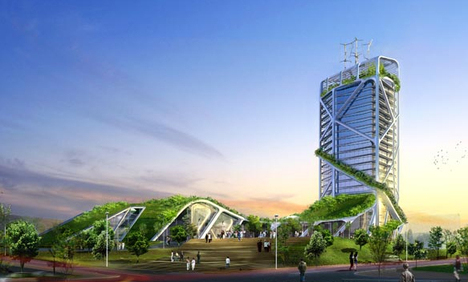
Yeang has pioneered the passive low-energy design of buildings, dubbed ‘bioclimactic skyscrapers,’ authored several definitive guides to ecological design and particularly green skyscraper design, is a visiting professor at many worldwide universities, and modestly runs architectural practises in the UK (where he has recently designed a green extension to London’s Great Ormond Street Hospital) , the US, and Malaysia.
“Green design is a bio-integration of the physical, systemic and temporal spheres,” Yeang told an audience of approximately 1,000 during the Conference’s opening address: “We must imitate ecological systems, which the human species may have destroyed or disrupted, and it should be built in that any potential green design will monitor and rectify any environmental damage.”
Biomimicry: seawater and solar
While Yeang’s buildings controversially try to use nature within them, by either incorporating planters vertically up and around the surface of the structure, and try to make links with urban wilderness that may surround them, another keynote speaker at the conference, Michael Pawlyn, gets his inspiration from nature first, using the term ‘biomimicry’ (first coined by writer Janine Beuyus), which he then applies to his design process.
He has used this most dramatically to great effect by designing the Biomes at the Eden Project in the UK. Here, in this pioneering development returning a quarry to life as the world’s largest showcase of different climate zones and biodiversity, Pawlyn and his team were inspired by dragonfly wings, and through an illustrated workshop as well as a keynote speech, Pawlyn constantly referred to elements within nature which feed into the human processes of imagination.
The turning point for his career was observing how the Nambian fog basking beetle uses its shell to attract water from the desert air at night to survive.
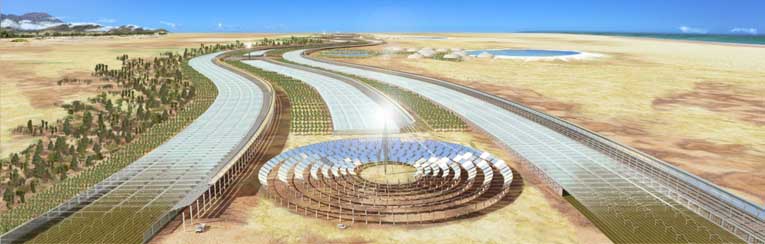
This sensitive exploration of processes within even the smallest eco system has led him to pioneer seawater greenhouses, that capture seawater and convert it to agricultural use.
Combining this technology with solar capturing techniques, Pawlyn is developing a Saharan Forest Project that he hopes will go some way to using the otherwise wasted potential of salt sea water and the heat of the sun, and move humans away from the ailing carbon-based economy.
Sustainable design in education
One of the most anticipated speakers was pioneering design architect Michael McDonough, who praised the building material Aerated Autoclave Concrete (or AAC for short, known here as Habel) as being the most environmentally friendly material he has worked with in 30 years of design and construction.
“This material I regard as a ‘wunderkind’, ” he announced to an audience of somewhat skeptical Israeli architects. “It is the lightest, strongest, most insulative material available, mold and mildew free, and will ensure any building has the potential to be a zero energy building (combined with the correct heating & ventilation systems). And all it is, is a combination of cement, lime, water and sand, caused to expand through the addition of aluminium powder.”
Other speakers included Israel’s own Nadav Malin, vice president and editor of ‘Building Green’ and ‘Environmental Building News’ (note to self: must get copies of those), Stefan Behnisch, Thomas Herzog, and another Brit, David Lloyd Jones, who has been at the forefront and sustainable redesigns for many schools in the UK.
To bring in local talent for his workshop, ahead of his trip to Israel, Lloyd Jones approached the Anglican School in Jerusalem and asked the students to do a sustainable redesign of their school. The students excelled in their brief, and displayed to the audience a large 3D model of their desired ‘rebuilt’ sustainable school, as well as a powerpoint walk through of it, complete with solar capture units and a gym and cafeteria powered by the (rarely) unending heat of the Jerusalem sun!
Hopefully these international students will be the sustainable architects of the future. Many thanks to the conference organisers at Yad Hanadiv (The Rothschild Foundation) and all the speakers, as well as the attendees, for a stimulating 2.5 days of green design and truly deep green collective thinking (even the conference programme was printed on recycled board).



[…] It’s pretty common these days to see pottery and household objects from Israel that are designed to resemble nature. While you may see pathways made of pebbles at resorts and spas, it’s not likely you’ll […]
[…] a foot massage! It’s pretty common these days to see pottery and household objects that are designed to resemble nature. And carpets too. While you may see pathways made of pebbles, it’s not likely you’ll […]