
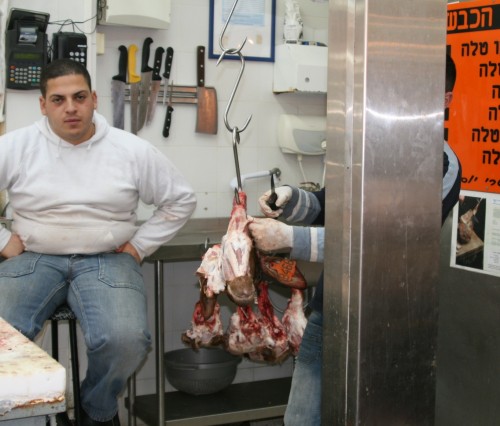

Back in January, I took a friend to the open food market in the Hatikva neighborhood of Tel Aviv, a run-down area near the Central Bus Station that used to be the home of Jews from Iraq and Yemen but of late has also seen a lot of Russian immigrants and foreign workers. We were looking for kubbeh, or Kurdish meatball soup, which in Hatikva is supposed to be fantastic.
As we walked through the market, we were shocked to see butchers there peeling the skin off goat heads and selling the skulls, offering pig feet in the glass cases, and hawking a whole array of other untraditional cuts of meat. Of course, this was only shocking because most meat vendors in Israel, and certainly the supermarkets, sell a short list of cuts, such as entrecote steak and sirloin for beef, chicken breasts and legs and lamb shoulder and leg. I don’t know what they do with the animals’ heads, feet or innards, which despite containing valuable nutrients seem to revolt most Israelis who can afford to avoid them. The result is a pickiness for choice cuts that forces more animals to be killed for the same volume of protein.
The New York Times this week reported on several New York restaurants seeking to change that outlook through “whole-animal cooking.” This piece shows how four restaurant owners order sustainably raised animals together, then divide the meat among them each week. The most recent load included an entire steer and two split pigs, which together weighed the equivalent of a Volvo. The beef comes with the “offal party pack” of oxtail, heart, liver and tongue.
When restaurants order these animals whole, they have to split apart the meat themselves. Often they take the tougher cuts and process them into sausages. The restaurant managers say that when chefs are so intimately involved in the meat they cook more efficiently and don’t waste it.
If you are interested in learning to cook alternative meat cuts, check out the recipes link on the right side of OffalGood.com.
Finally, it’s worth noting that these whole-animal chefs who get creative with slaughtered pigs are clearly not kosher. If you are in the United States and looking for some kosher, organic meat options, check out Mitzvah Meat and Kosher, Organic and Local. And don’t forget to ask for the innards.



[…] otherwise known as “meat glue”. Read on to consider some very good reasons for buying a whole animal or meat from organic sources. Much “fresh” meat in supermarkets is actually thawed from frozen […]
[…] otherwise known as “meat glue”. Read on to consider some very good reasons for buying a whole animal or meat from organic sources. Much “fresh” meat in supermarkets is actually thawed […]
[…] well for families who buy whole organic animals or families who are hunters. When you buy animals whole there are bound to be some less desirable parts. Some of the trimmings that are tough and too chewy […]
[…] well for families who buy whole organic animals or families who are hunters. When you buy animals whole there are bound to be some less desirable parts. Some of the trimmings that are tough and too chewy […]
[…] more on Paleolithic-type eating: Eat the Whole Animal: Lamb’s Testicles Whole Animal Cooking Making Smen the Old Fashioned Way This entry was posted in About Nomad. Bookmark the permalink. […]
[…] more on Paleolithic-type eating:Eat the Whole Animal: Lamb’s Testicles Whole Animal Cooking Making Smen the Old Fashioned […]
[…] more on Paleolithic-type eating: Eat the Whole Animal: Lamb’s Testicles Whole Animal Cooking Making Smen the Old Fashioned […]
When I lived in England, I used to buy meat in bulk from a biodynamic (organic with a spiritual tip) farmer friend of mine in Somerset. For a set price, he’d sell a box of different cuts from a particular cow – ours was called ‘Buster’ – as well as half or quarter lambs, which would go in the freezer and feed my house for the next couple of months.
The farm had never had any fertilisers or chemical sprays on it and the meadows on which the animals roamed were rated among the highest in the country for biodiversity. We knew where the meat came from, how it was reared – and will never forget get how it tasted. We had good times with ‘Buster’.