



The world’s first moving building, Dynamic Tower, a skyscraper with 80 independently rotating floors, is being planned for Dubai (which has big green plans for 2008), with another 70-storey structure to be built in Moscow.

These cutting edge buildings, over 400 meters tall, will be constructed of prefabricated sections mounted on a central concrete core, at an estimated cost of $700m. Catering to the upper crust, apartments are priced to sell at $3.7m – $36m, and will include such necessities as in-house parking, indoor swimming pools, voice controlled systems and an ever changing view.


Aside from the tremendous “cool” factor, the design incorporates a number of advanced environmental building principles.
Ecological Advances on the Squall
Wind Power from the Squall
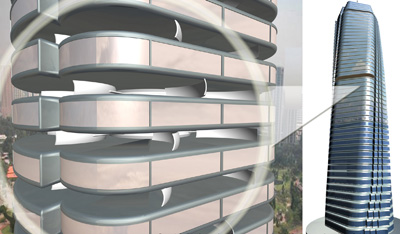
The power for the building will be supplied by horizontal wind turbines installed between the floors, thus avoiding the visual impact, one of the major drawbacks of the familiar “propellor” turbine. The blades are designed and constructed of materials to allow for quiet operation – a necessary feature, since they are only meters away from the residents. The architect, Dr. David Fisher, explained wind is a problem for most skyscrapers, and he decided to make use of it instead.
Solar Power on the Squall
Photovoltaic solar panels will be installed on the roof of each rotating floor, and because they are constantly in motion, 20% of each roof will be open to the sky and to the sun.
These sources are designed to generate more electricity than is used in the building, and to make this the first skyscraper that is self-powered.
Prefabrication for the Squall
The individual units will be manufactured off-site in a dedicated factory, thus reducing the costs by about 10% and increasing the efficiency of the construction by 30%. Prefabrication has the added benefit of allowing for a cleaner construction site, with a simpler and shorter process of assembly, less use of resources and energy, and minimal site disturbance.
High Density Building
High rise construction is an efficient use of area with a reduced footprint, as opposed to sprawling, low density development.
Eco Building Materials
The use of natural and recyclable materials, insulated glass and structural insulating panels.
Natural Lighting
The units in the building should have sufficient natural light from the large expanse of glass and the rotation.
By 2022, there has been no news if this concept skyscraper will ever be built.



[…] and research environments, as well as in residential ones. Each building incorporates a “solar tower” (another “innovation” used in early Islamic architecture) that heats the air, causing it to […]
[…] […]
[…] http://www.greenprophet.com/2008/09/wind-powered-building-in-motion/ […]
[…] Dubai’s wind powered rotating skyscraper is building in […]
[…] Dubai’s wind powered rotating skyscraper is building in The world’s first moving building, dynamic tower, a skyscraper with 80 independently rotating floors, is being planned for dubai (which has big green plans for 2008. […]
[…] Dubai’s wind powered rotating skyscraper is building in The world’s first moving building, dynamic tower, a skyscraper with 80 independently rotating floors, is being planned for dubai (which has big green plans for 2008. […]
[…] Dubai’s wind powered rotating skyscraper is building in The world’s first moving building, dynamic tower, a skyscraper with 80 independently rotating floors, is being planned for dubai (which has big green plans for 2008. […]
[…] Dubai’s wind powered rotating skyscraper is building in The world’s first moving building, dynamic tower, a skyscraper with 80 independently rotating floors, is being planned for dubai (which has big green plans for 2008. […]
[…] Dubai’s wind powered rotating skyscraper is building in The world’s first moving building, dynamic tower, a skyscraper with 80 independently rotating floors, is being planned for dubai (which has big green plans for 2008. […]
[…] Dubai’s wind powered rotating skyscraper is building in The world’s first moving building, dynamic tower, a skyscraper with 80 independently rotating floors, is being planned for dubai (which has big green plans for 2008. […]
[…] Dubai’s wind powered rotating skyscraper is building in The world’s first moving building, dynamic tower, a skyscraper with 80 independently rotating floors, is being planned for dubai (which has big green plans for 2008. […]
One should have to face many difficulties while doing
the relocation work. One should have to do hard slog to mqke their relocation easier.
Show uup promptly on moving day, be courteous, and work hard.
My siute … moving house tips
hey there and thyank you for your information – I’ve definitely pickrd up anything new from right here.
I did however expertise some technical issues
using this web site, since I experienced to reload the web sie a
lot of times previous to I could get it to load correctly.
I had been wondering if your wweb host is OK? Not that I am complaining,
but slow loading instances times will often affect your placement in google and can damage your high-quality score iif
advertising and marketing with Adwords. Anyway I’m adding this RSS to
my email and could look out for a lot more of your respective interesting content.
Make sure you update this again very soon.
My homepage … alternative to Fusion back surgery
We’re issuing out 10 dogecoins for the very lucky winner of a blog site manager
with the decided on prize coupon code. The final results is
normally delivered in 4-weeks time. Your prize code is: IUJAW3
Dubai is already bankrupt, and it’s building stupid things like this that has done it to them. A good example of what happens when you have rich people run things without democracy.
I am concerned about how this moving building will withstand an earthquake. It seems like a fragile structure when the earth is shakling and trembling. I love those wind turbines though. Is amazing to think that this building will be self powered.
Its amazing..
How many cost constructed for the building.
[…] Dubai, United Arab Emirates, has emerged as a center of modern architecture that stretches the imagination, such as the “Wind Powered Rotating Skyscraper is Building in Motion.” […]
Pretty section of content. I just stumbled upon
your blog and in accession capital to assert that I get actually enjoyed account
your blog posts. Anyway I will be subscribing to your augment and even I achievement you
access consistently quickly.
Well that just looks and sounds amazing! Where these builds or even types of building like these ever built like planed?
It must have the scariest fire escape in the world
This is real its on national geographics book! 🙂
[…] grand plans before the Real Estate crash in 2009? We’d caught wind of underwater mosques, a wind-powered spinning skyscraper and underwater hotels. To reminiscence on what could have been, let’s look at Hydropolis. […]
Is the moving building done? If not how far along is it now? Frank
Crazy idea…almost too crazy to become real, but to be honest, I’d love to see this building being built.
I salute the architect Dr. David Fisher because it is not easy to construction of skyscraper It is a unique idea in the World…
do you have any posters or mini models you could donate to our after school program?15-25 kids average 15 per day at our residents service
do you have any posters or mini models you could donate to our after school program?15-25 kids average 15 per day at our residents service
checking out what's going on in Dubai. Massive buildings, innovative sustainable development. wind powered rotating blgd? http://ow.ly/14TDD
[…] Dubai’s wind-powered building in motion has sparked a lot of interest this year. Even though this story was written in […]
I guess this will be on hell of a contruction and arhitecture,although in Dubai I dont think their is something imposible regarding construction.______________________________Motion to File Document Under Seal
This is a very unique and cool idea. I am amazed that those blades will capture enought energy to spin that building, I also hope it has a braking device just incase of superspeed gusts. I would move in, but the price tag seems to be a little much.
This is a very unique and cool idea. I am amazed that those blades will capture enought energy to spin that building, I also hope it has a braking device just incase of superspeed gusts. I would move in, but the price tag seems to be a little much.
We’ve been wondering about the plumbing, also. One thought was a circular sealed trough that allowed a waste pipe to move along with the building’s rotation. another thought was a holding tank that would allow for dumping after the rotation was complete and located at specific intervals along the core. Kind of like a docking station for a space module that would lock into place after rotation is complete and automatically empty the tank. Would love to see the plans!
Technically, the planned wind turbines (“power for the building will be supplied by horizontal wind turbines”) will not be horizontal. Wind power generators have two classes: HAWT and VAWT; the difference being the plane on which the axis lies, horizontal or vertical. Since these will be mounted on a central vertical structure that makes these plans for a VAWT.
Otherwise, interesting idea. S
BUT, who gets to decide which side of the structure faces which way?
J
wow, great news
Dubai’s Wind Powered Rotating Skyscraper is Building in Motion: http://bit.ly/KPDh8
Can you describe the impact on society that the rotating skyscraper has?
I can’t figure out how they are going to run water/sewer pipes into a rotating building with standard technology. Has anyone else thought this through and figured it out. I envision plumbing/electric running up the center, non-rotating portion of the building, but how can you pipe that out to the rest of the building.
My only thought is that the building cannot continually rotate in the same directions. Rather, it has to oscillate it’s rotations back and forth, and then they can use flexible piping.
Yes, in that case they could use flexible piping, but then you would have to deal with some major motion sickness. That’s why I don’t think this is possible: Either you have motion sickness or you have impossible piping.
This all seems like a really bad idea in the first place.
amazed by Dubai’s plans for utelizing wind energy!
http://tinyurl.com/4usbqe
I’ve been following more coverage of this project – apparently there are plans for one in New York City (but where would you put it so that it can be seen…)
One of the criticisms I’ve read: how does the plumbing work? How would you attach pipes in the moving section to the stationary core? Or maybe you just have to put the toilets, showers and sinks in the central core.
This is the most amazing, intelligent building I have ever seen. Even in sci-fi movies…
That building will be looking nice, intelligent, green… just awesome.
Valerie, I should have written “the world’s first moving skyscraper.”
I stand corrected…
Daniel
This will be a good way to offset some of the less green things that are done in Dubai – developments like Palm Island and The World have been criticised for the disruption they cause to marine life etc.
It is a very cool building, but not the world’s first moving building. (see treehugger’s http://www.treehugger.com/files/2008/08/1935-house-follows-sun.php)
I don’t think this is the only one, either.
this is amazing, will be a sight to see if it is ever built