

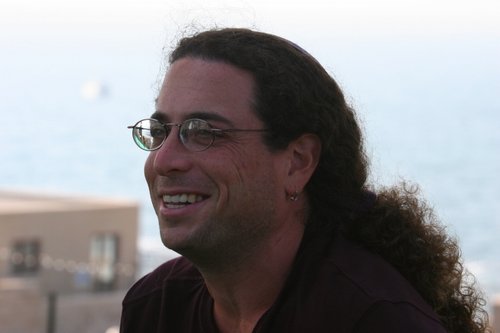
He’s a tour guide, educator and environmentalist. Meet Jared Goldfarb, who has a unique take on eco-tourism, and ways to lighten your travels in Israel. Whether you’re just visiting for a few days, or live here, Jared offers some advice for the thoughtful — and curious –– traveller.
Tell us a little about what you do? I am a freelance Jewish educator and Israel educator – both of which can mean many things. For 8 years, I served as Program Director of Ta Shma: Pluralistic Jewish Learning, and I continue to teach Jewish text for numerous institutions. I also teach the history of the Land of Israel and modern Israeli history in various frameworks, including year-in-Israel programs for young Jewish adults, international biblical study programs for Christian clergy, and multi-faith missions that use this land and its narratives as a common ground for dialogue.
In addition, I’ve been a licensed tourguide since 2000, and in that capacity work mostly with families and small groups looking to create a meaningful Israel experience.
Paint us a picture of a typical week at work: Thankfully, there is no such thing in my life. Otherwise, I’d probably get bored by the end of said week! One of the things I love most about being a freelancer is the ability to pick and choose (and even design) the work I want to do. It’s a little scary when it comes to financial stability, but I’ll take the excitement of running from an Early Rabbinic text study session on the Temple Mount with 70-year-old priests to a sea-kayaking expedition with a deaf family celebrating their son’s bar mitzvah any day.
How would you define Eco-Tourism? Quite simply, as any interactive experience with the country you’re exploring that involves a heightened awareness of the natural surroundings. That could be anything from understanding the preservation process of an ancient archaeological site, to taking note of a neighborhood that seems to have an inordinate amount of litter, to witnessing the local flora and fauna that pre-date any historical event you may be learning about.
Most people seem to think that Eco-Tourism means bringing tourists to where the environmental issues are, i.e. fitting a clean-up hike into your program, meeting an activist to discuss recent legislation, or staying in an eco-friendly cabin in the woods.
I prefer to see EcoTourism as bringing the environmental issues to where the tourists are, i.e. adding that extra layer of conversation and/or action to whatever’s on the itinerary. In short, the “Eco” bit isn’t what you do and see, it’s how you perceive what’s in front of you.
Does it exist in Israel? How so/not? Hmmm, yes and no (typical Jewish response, I know). On one hand, there are so many exciting and unique eco-initiatives in this small country, you can’t help but include that element in any Israel visit. Also, much of our attraction as a tourism destination is based on the land itself, and that obviously provides endless opportunities to explore our relationship with nature.
A perfect example is the Dead Sea region, which I’m sure sees more tourists than Jerusalem each year. You have a historical site at Masada (where one could explore the human fascination with – and reliance on – the desert), adventure activities at Ein Gedi (where one can meet biblical beasts up close and splash in nature’s water cycle), and medical tourism at the Dead Sea (where we must ponder the consequences of our manipulation of natural resources).
On the other hand, there is such an intense focus on religious sites here and their political context, many tourists simply get lost in their passion (or worse, are egged on by a similarly single-minded guide) and, pardon the expression, can’t see the forest for the trees. As a religious Jew, I am certainly in favor of encouraging tourists of all faiths to take advantage of Jerusalem’s historical “proximity” to God, and engage in communication with their maker, savior or spiritual guide.
But why, oh why, must we perpetuate the tradition of writing notes to be slipped between the cracks of ancient stones? If you did that anywhere else in the city, you would be fined! It’s no secret those notes get cleaned out of the wall twice a year and buried according to Jewish ritual. So why chop down more trees, only to bury them in a landfill (a holylandfill no less!)? Wouldn’t God prefer we simply speak our mind?
If a tourist is interested in an EcoTour of some sort, what kinds of places would you choose and why? Again, I’d start by explaining that any tour can be an EcoTour, especially if I’m the guide and can address those issues in an educated way. I’d stress the importance of seeing the key sites throughout the country in order to understand their historical relevance as well as the modern reality, only we’d do it through an eco-lens.
 If a tourist were to insist, I’d certainly be happy to visit additional nature reserves, organic farms, water desalination plants, etc., in order to help them understand how those projects are uniquely Israeli in whatever way (survival in a harsh climate, reason for military conflict, opportunity for cross-cultural cooperation, and the like).
Another less-obvious approach to organizing an EcoTour would be to examine the behind-the-scenes aspects of any standard itinerary. I often encourage clients to walk from site to site, or use public transportation, rather than unnecessarily rent a private car. When working with large groups especially, I remind everyone to refill their water bottles rather than buy new ones, or at least to recycle the old ones. And when it comes time for lunch, I try to choose (or recommend) restaurants that I know use local, healthy ingredients, and don’t serve customers on plastic plates.
Do you know of any environmentally-friendly hotels/hostels in Israel? Please explain.While there now seems to be an abundance of eco-friendly guesthouses (“tzimmerim”) in Israel (and it wouldn’t be fair to mention only one), what concerns me most is the utter lack of environmental awareness in the mass-market hotel industry here. The tremendous waste of food (oy, the breakfast buffet!), water (showers that could propel a motorboat!) and electricity (all in the name of “customer service”!) drives me crazy.

I’m all for convincing a tourist to stay in an eco-tzimmer, but that won’t solve the problem of the millions of tourists who blindly stay in commercial hotels and hostels. The entire tourism industry needs an overhaul, and I’m not loud enough make that happen.
Are there any standards bodies in Israel that are regulating or standardizing the field of Eco Tourism? We’ve seen a website advertising Eco-Tourism in Israel, and wonder by what standards are the hotels and activities being chosen? As far as I know, the industry is not at all regulated, so anyone can market their establishment or service as “eco-friendly”. Then again,even in the case of organic food in Israel, which thankfully does have a certain amount of legal definition and oversight, I’m a very vocal proponent of personal responsibility. That is, just as you should get to know the farmer who grows your food, and the environment in which it is raised, you should demand that your tourguide (or you, if you’re local) know each and every component of your Israel travels, and insist on certain standards.
Does the Tourism Ministry coordinate with the Ministry of Environmental Protection?Does any government body in this country coordinate with anybody? 🙂 Sorry, I had to. Yes, there has been much press recently of the Tourism Ministry’s attempt to “green” the industry, but my experience has taught me to be very skeptical until I see results. At the end of the day, with or without the government, tourguides and tourists alike can create change by simply educating themselves and demanding a standard of service.
What’s your all time favorite place in Israel? If we’re talking about specific sites, I’d have to go with Tzippori, capital of the Jewish Galilee under the Roman empire, after the destruction of the Temple and Jerusalem. While it is literally a “green” site (surrounded by nature with minimal infrastructure, well-preserved archaeology, and recycling bins), I love it because it embodies the peak of the rabbinic revolution.
As the Jews struggled to define their identity in light of the powerful Hellenistic culture that pervaded every corner of this land, Rabbi Yehuda Hanasi redacted here the Mishna, enabling the tradition of makhloket (constructive disagreement about Jewish life and practice) to thrive, even as the Jewish community became more and more dispersed. I believe it was this ability to engage in debate and acknowledge different opinions that helped Jews survive wherever they journeyed. We still have so much to learn from them.
I’m also a big fan of the tombs of Druze sheikhs, as that community believes the holiness of the person imbues the surroundings with spiritual significance, and therefore they protect the immediate environment. Some of the oldest, most beautiful trees in the country can be found alongside these grave sites. Sadly, dead Jewish guys don’t seem to have the same effect.
If you had an unlimited budget to organize the dream Eco Tour, what would you do? It could be anywhere in the world.
Honestly, if I’m the guide, I’d do it right here in my backyard. We’d bike from site to site, do lots of learning, camp out at night, eat only local organic food, and clean up trash as we went. It’s that simple (and I’m that boring!).
Please let us know how Israel can improve in this area. It’s so easy – we just need to think about every little thing before we do it. Consider the consequences. Ponder our responsibilities. Contemplate what’s important in life. Oh yeah, and make peace with our neighbors (yes, the ball’s in our court, not theirs). Conflict really sucks for the environment!
Interested in exploring Israel with Jared? Email jared (at) pobox (dot) com. Or drop us a line and we’ll pass on your message.
Green Prophet has a number of eco-tourism stories. Start with:
Guesthousing In Israel – Get Your Eco-Farm On
Green Prophet Visits Amirim, a Vegetarian Paradise in the Galilee
Adam and Eve: An Eco Farm Paradise in Modiin



Hi Jared,
I attended your lecture at Congregation Netivot Shalom last year. I am helping organize a “Israeli Innovations Fair” to be held this August 30th in Berkeley and wondered if you or a colleague may be able to attend. We are trying to showcase Israeli innovations that have helped humankind. I immediately thought of you!
Thanks,
Marilyn Sarig
Contra Costa Bridges to Israel
[email protected]
[…] and over again in the forums that I read.Perhaps my all-time favorite tour in Israel was run by Jared Goldfarb – he called it the “Four Quarters” tour. Rather than focusing on the history of […]
Hi Jared
It’s 7:30 pm here in White Plains and I didn’t want to wake you with a phone call. Having just read my previous e-mail to you I realize how fast time goes by. This will be brief. Apparently on the strength of Rachel’s participation in Young Judea’s Year Course during the 2000-01 school year, she has been asked (she did not apply) to be a counselor on a six week tour run by New Jersey Y Camps for their oldest campers. In a discussion with the head of the program, the subject of tour guides came up. With incredible enthusiasm, Rachel strongly recommended you. That is the reason she has been trying to get in touch with you, if she hasn’t already done so. I don’t know the exact dates; but I assume it starts at the end of June or the beginning of July. Even if you are already committed, please contact Rachel so that she can describe the program for you. Her e-mail address is [email protected]. She has a face book and her cell phone number is (914) 519-7162.
I hope all is well with your brood and I know that work is extremely rewarding for you. Needless to say, if you are ever planning to come to the U.S. please let us know; we’d love to see you and we even have guest facilities.
On another subject, I may have mentioned that my 35 year old niece, Naomi Katz, has made Aliyah. She is very much into the whole ecomovement and spent more than a year running an eco farm/school in Modi’in. She is now living on a Kibbutz near Eilat. You might enjoy meeting each other. If you are interested, let me know and I’ll give you her contact info.
When you respond, please let me have your e-mail address.
Joel
Shalom u’vracha.
Joel
Hey Jared:
You may remember us and our two kids, Rachel d.o.b. 03/09/92 and Rafi d.o.b. 21/10/97, from our visit in February of 2008. Well we certainly have not forgotten you and your spectacular, informative, sensitive, insightful and thoroughly entertaining guiding for our family. And I’m not being hyperbolic!! Well, after graduating from White Plains High School, Rachel has just begun a nine month stay in Israel as a member of Young Judaea’s Year Course. She has already been accepted at the University of Rhode Island which has allowed her to defer her admission for one year. We are planning on visiting her from December 23rd through January 3rd and we would love to have you do some guiding for us. Are you available on some or all of these dates? We certainly hope so.
Rafi and we have been kept pretty busy preparing for his Bar Mitzvah this coming October 30th. Time just goes by so quickly.
How is your family? Have you added any new members? I have to believe that your guiding work keeps you quite busy, being as good as you are.
We look forward to hearing from you. Please let us have your address and phone number.
Joel
Law Offices of Joel B. Lieberman
66 Richbell Road
White Plains, NY 10605
Phone: (914) 686-6648
Fax: (914) 288-9887
Please disregard my last email.
thanks!
Jared:
I hope you are well and prospering. People are still talking about how wonderful you were and teasing Bruce about how he took to your kids.
I have a wonderful family that I would like you to take around Israel. They are celebrating their daughter’s Bat Mitzvah at the Conservative part of the Temple area (Robinson’s Wall?) and they are one of the brightest families I have come across in a long time (including my own!!). You would love them. Bright, warm, engaging. Really mensches.
They are coming for two weeks — just the parents and daughter 13 and son 10. The Bat Mitzvah is on June 18th. Are you available around that time?
Speed is of the essence as most of their arrangements are made, but I sang your praises to them. They supposedly have someone, but clearly he/she could not be as wonderful as you.
Let me know soon so I can get you all together….
Best,
Marilyn (Steinthal) Still unemployed…..