
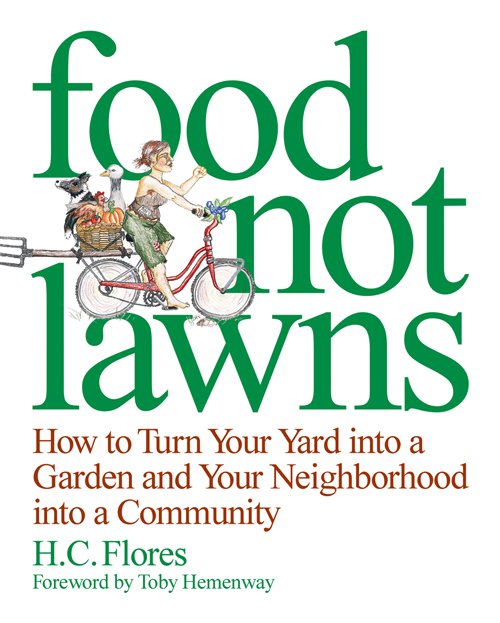

I finished reading Food Not Lawns on my roof, just after I checked my new vermi-compost bin. The roof compost represents my adaptation to life in the modern world whereby I try and lead a more sustainable lifestyle within my means and ability. I was hoping to read Flores’ book and gain tips on how to build and maintain an edible yard in my future home, and possibly how to manage to grow edibles in the most unlikely of places like a concrete wasteland in Tel Aviv.
As it turns out, I was in for a bit of a surprise.
Flores sets out to write two books: the first on how to convert one’s lawn into a garden and thus live a more ecological life (in which she includes sweet anecdotes and exercises like planting one’s self in their own garden); and the second on how to reject modernity and reclaim our land, government and culture from post-industrial life.
I’ll begin with her first book. Flores is clearly an accomplished landscape designer and permaculturist, though her writing is a bit dry. She starts each chapter with a brief, somewhat vague meditation on the state of our modern world:
“In this modern age of fast-paced electronic consumerism and global violence…many people have lost touch with their natural instincts,” she writes in a typical lament of society. “The average person in the United States knows over a thousand corporate logos but only ten species of plants.”
The book really shines once it revels in the details of how to build a thoughtful and effective garden. The tips that stick out in my mind are how to build effective gray-water systems which reuse sink and shower water in the garden. “Slime monsters” can be built to purify your reused water by building a mini ecosystem in a reused plastic half-barrel replete with woodchips, soil and plants. Thus, water can flow from your sink to the slime monster to the irrigation channels that will water your garden.
Flores also explains composting and principles of biodynamic farming, and perhaps most fascinating, how to brew compost tea to use instead of buying expensive fertilizers (really just put compost in a sock and stick in a barrel of water like you would a tea bag and use a pump to agitate the brew for 24 hours).
The book also includes important lists on which plants to consider planting and how to choose one’s own gardening goals and how to select for plant-life to match those goals.
Armed with information and useful tips from her chapters on the water cycle, soil, plants and polycultures, seed stewardship and ecological design, I felt ready and eager to begin laying my own garden plans. “If you want to garden you have to get dirty,” Flores reminds the readers, and I was ready.
Replacing our wasteful and preposterous lawn culture, for which Americans devote a significant amount of their water supply, I felt, is a wonderful way of adapting and improving our interaction with modern life. Plus, gardening is an integral part of a healthy lifestyle, a point Flores stresses over and over again. She reminds readers to “love your hammock as you do your pitchfork….”
Flores writes nicely about the importance of polyculture and diversity in one’s garden and articulately criticizes monocultures in America.
She warns, “…don’t base your food security on just one, two or even fifty species,” and proceeds to offer ideas for how to save your own seeds and exchange seeds with other gardeners. Surprisingly Flores hardly devotes any time to the fascinating history of lawn (mono)culture in America that has been written about both by Michael Pollan in Second Nature and more recently by Elizabeth Kolbert in an article in The New Yorker. It was a disappointing omission, and just proclaiming that it’s time to reclaim our lawn didn’t quite cut it in my opinion.
In fact, Flores’ book quickly veers from an ecological how-to into a treatise on ecological activism. Flores comes out of an anarchist tradition, and as a former Greenpeace activist and founder of the non-profit organization Food Not Bombs, her activism is well known in various environmental circles. In her book she suggests that ripping up concrete and asphalt to make room for edible gardens is in itself a form of activism, a protest against the modern system, which on its own is a nice thought.
Stop the Clocks, Quit Your Jobs
Although she isn’t interested in reaching millions of people by convincing them to take the source of so much waste and pollution—our lawns—and alternatively converting them into abundant sources of food for our families and community, rather, Flores goes one step further and proscribes how to live the most ecologically sensitive existence, suggesting quitting jobs, getting rid of clocks, mirrors, alarms and engaging in radical community action.
I actually agree with her on certain ideological levels, but for a host of practical reasons I think she misses the mark. For starters, without jobs most people can’t afford homes or lawns in the first place. Secondly, I believe that striving to adapt the modern world to our environmental needs is more realistic and beneficial to a majority of the world than foolishly hoping that millions of Americans will suddenly throw out their watches and begin living a fully subsistent agrarian lifestyle. I was left with the thought that Flores has existed too far outside of the mainstream to be a relevant voice on just how to make modern life more sustainable.
I think Flores officially loses me by chapter 9, “Into the Community,” in which she provides advice on protests and demonstrations. “Sometimes even a small demonstration can quickly become violent, usually (in my experience) as a result of police overreaction to civil unrest,” she writes. “In just a few minutes things can get really crazy and a lot of people can get arrested, beaten, tear-gassed, and sometimes killed by police.”
Aren’t we talking about gardening? She continues to offer advice on activist training camps to learn how best to prepare for civil disobedience.
The book then continues on for three more chapters on community organizing and how to run an effective meeting and how to teach gardening to children. Her book strays considerably from what I presumed it to be about. Somehow she also finds room to offer advice on scrapbook making and how to throw a party. Yet, in the section on composting Flores writes that there’s not enough room to explain vermi-composting in detail and that the reader should read other books to attain such information.
At the end of the book it became clear to me that I had just read a cultural manifesto, a how-to guide on radical activism and living in the fray, in which reclaiming land to grow food is just one way to defy the mainstream.
When I have a house with land I will certainly use Food Not Lawns to plan my garden and gray-water system, and the book will be a vital resource for me. I would recommend this book to those who see their sustainable living as radical activism (which sometimes includes me), but for those aspiring gardeners, I’d peruse the gardening section at your local book store for something a bit more, well, useful.
Food Not lawns: How to Turn Your Yard into a Garden and your Neigbourhood into a Community
By H.C. Flores published by Chelsea GreenPublishers (USA) & distributed in the UK by Green Books
Reviewed by Green Prophet Jeff Yoskowitz.
This review is part of Green Prophet’s summer ‘eco-reads festival’. Read more eco-book reviews below:
‘Earth Shattering’ Poems
‘Animate Earth’ by Stephan Harding
‘Field Notes From A Catastrophe’ by Elizabeth Kolbert
‘The Emerald Planet’ by David Beerling
‘Confession’s Of An Eco-Sinner’ by Fred Pearce
‘Green Gardener’s Guide’ by Joe Lamp’l


Jeff, well done, sir!
Sounds like a very interesting read. I will definately have to pickthis up. Thank you for posting about it. I found your site last week and find it very interesting and will be coming back for more. Thank you once again.