
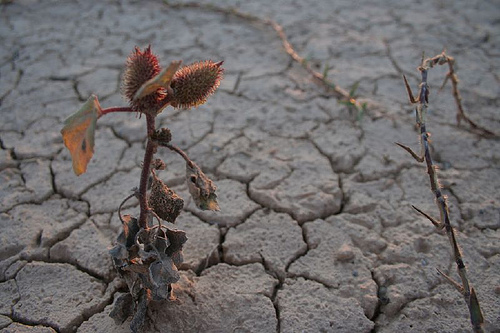
Israel Lacks National Plan to Address Climate Change

plants drought climate change global warming Israel Mediterranean

The chief scientist of the Ministry of Environmental Protection, Yishayahu Bar-Or, released a statement yesterday Aug. 4, (and here [in Hebrew]) warning of the well known consequences of global warming that are expected in Israel and the Eastern Mediterranean. 

These include a rise in average temperature of 1.8 degrees Celsius already by 2020, a rise of 10 cm in the Mediterranean Sea above the 8 cm rise in the last 15 years, a drop of 10% – 20% in precipitation, and extreme weather events.  These will cause the degradation of fresh water resources and the spread of pests and diseases, leading to severe public health problems.

Dr. Bar-Or called on the Government to establish a national program to deal with these potential disasters, and identified the opportunity for Israel to leverage its vast experience in water innovations and solar technologies to position itself as a leader in dealing with the problems caused by global warming.

Israel is one of the few western countries that has yet to recognize the problem of global warming at the national level, and the government has so far neglected to address the problem seriously.  The Minister of the Environment, Gidon Ezra – instead of fulfilling his role of actively promoting action on environmental issues –  reportedly excused the neglect of climate change by citing Israel’s many priorities that allegedly precede the environment: security, education, social equality and economic development.

Bar-Or’s report predicts billions of shekels in economic damage every year if the country does not prepare itself.  But Israeli experience teaches us that action is taken only when disaster strikes:  take for example the current water crisis, which has been foreseen, forecasted, and predicted regularly for over 20 years.  The causes are described in agonizing detail, and the solutions suggested and presented: water conservation, elimination of waste and responsible use of the existing water resources.  But just give us 2 months of rain, and all of the plans go out the window.

As individuals, we can all do our part towards reducing greenhouse gases and saving water until we’re green in the face.  But real change will only happen when the large scale processes start, and that will require action at the national and government level.  This requires public action to influence public opinion and government policy, and this can be done through joining the activities of the environmental organizations.

So act fast, Act Now before our 100 months are up!


Photo:

View Daniel Pedersen, PhD's profile on LinkedIn

Daniel Pedersen
Daniel Pedersenhttp://www.greenprophet.com
Having spent my Jerusalem childhood ear-deep in science fiction stories, I’m still waiting for clean and abundant fusion power. On the way, I dabbled in solar-powered desalination and alternative building technologies at Swarthmore College, and studied the chemistry and mutagenic effects of particulate air pollution at MIT for a PhD in environmental engineering. Since returning to Jerusalem in 2002, I’ve directed air quality research campaigns from Rosh Hanikrah to Eilat & Aqaba for Hebrew University. I’ve led cooperative regional projects, wrote a successful proposal for the largest air-quality study in the history of the Middle East, and established the first monitoring network in Palestinian cities. Last year I edited a weekly TV environmental spot on Channel 2 and wrote a companion blog. At Hadassah College I train the next generation of environmental science professionals, audit Israel’s chemical and environmental laboratories for the Israel Laboratory Accreditation Authority, and provide environmental consulting services to diverse clients. Daniel can be reached at daniel (at) greenprophet.com.

Read More

TRENDING

Understanding Food Production: Karl Studer on the Urban-Rural Knowledge Gap

Karl Studer occupies an unusual position in American business. As President of Quanta Services, he oversees electrical infrastructure operations across the United States, Canada, and Australia, managing thousands of employees and multibillion-dollar projects.

Wave wind energy for Nvidia’s next AI energy boom?

As AI factories consume unprecedented amounts of electricity, NVIDIA is looking beyond chips and data centers to the ocean. The company recently spotlighted Israel's Eco Wave Power and its wave energy projects in Jaffa and Los Angeles, highlighting how AI, digital twins and renewable energy can work together to meet future power demands. The collaboration reflects a growing realization that the future of artificial intelligence may depend as much on clean energy infrastructure as it does on computing power.

Weston Higginbotham found dead in a Kyoto forest: is climate anxiety part of the story?

In some ways, Weston has become a symbol of a generation wrestling with environmental and technological anxiety. Friends and family described him as deeply concerned about environmental issues. Reports also noted that he questioned the growing role of artificial intelligence in daily life, even reportedly disagreeing with his mother about her use of AI.

Billie Eilish’s Mom Takes the Stage at Hollywood Climate Summit — But Does Hollywood Still Care About Climate Change?

Hollywood once promised to help save the planet. Leonardo DiCaprio warned of climate catastrophe from awards stages. Celebrities flew to climate conferences. Studios pledged greener productions. Streaming platforms rushed to commission environmental documentaries. But in 2026, with the aftermath of wildfires, heatwaves and floods becoming routine, a question lingers: Does Hollywood still care about climate change?

Can Scientists Predict Coral Bleaching Before It Happens?

Now researchers at the Woods Hole Oceanographic Institution (WHOI) in the US say they have developed a way to predict coral bleaching five to six months before it occurs, potentially giving reef managers enough time to intervene and save vulnerable corals.

Yerukim Forms a New Green Economy Where the Money is Really Green

The Yerukim members who pick up the recyclables get to keep the monetary reward, the public earns "green" bills that can be used in shops, and business owners get to be associated with environmentalism.

Choosing Riyadh over Dubai? What Investors Should Know

Saudi Arabia is deploying capital at unmatched scale to catalyze tourism and advanced industry while rewiring its power-and-water backbone. The investable frontier is widening—especially in renewables, grid storage, water efficiency/desal retrofits, and hospitality operating platforms. Prudent investors will insist on phased delivery, enforceable KPIs (energy, water, biodiversity), and RHQ/zone compliance—while pricing political-economy and reputational risks alongside growth upside.

Sell your cooking oil for biodiesel money

Want to make money on old french fry oil? Sell it.

Qatar Alternative Energy Summit Pairs Investors And Innovators

Alternative energy investors and innovators can meet n' greet in Doha, Qatar March 16 and 17.

Here’s How To Implement The Four Pillars Of Employee Engagement

If you throw a party for your work team and they are vegans, don't make it a barbecue. Know the sustainability values of your team to boost moral and retain good people.

Locals From Rishon Fight IKEA

Big Box stores are a pretty new concept in Israel, and thank God that not every Israeli city wants them in their backyard. A word from someone who has see the beautiful farmland around her hometown Newmarket, Ontario stripped and converted into vulgar strip malls of big box shops: they have no place in a healthy and sustainable town or city.

The Jewish National Fund Meets An Inconvenient Truth

According to the JNF, it has transformed thousands of acres of barren land into green forests in Israel. They state that each person emits about 23 tons of carbon per year, estimating that each tree planted can absorb one ton of carbon in its lifetime. That's a whole lot of trees you'd need to be planting. Could so many fit in Israel?

How to quiet noise from construction in your office

Streets need to be resurfaced in New York but the humming and grinding noise is unsettling. Noise is environmental pollution. 

Popular Categories