



Today is devoted to the sheer joy of growing something, in this case, an organic gooseberry bush (Latin: Ribes Grossularia).
Growing something – anything really, from a geranium stem, roughly transplanted and shoved in soil, to vegetables for your plate; can be a mystical experience. It mesmerizes, absorbs, transfixes … and continues the biblical evocation of mankind in the Garden of Eden.
Ultimately, planting something is beneficial for the environment – a universal give and take between all the elements needed for the plant to grow is undertaken, and humans are (for once) on the margins of the process.
Over a year ago, I brought back from the UK a packet of organic gooseberry seeds, picked up from a garden centre. Dutifully planting these seeds in a plastic plant tray (one of the cheap and ugly green ones found everywhere around this country), the 40-odd seeds slowly budded and become little plant-lets.
The soil was a mixture of home-baked compost and garden centre fine potting soil – maybe the stuff with tiny polystyrene balls in. The argument for using these is that they aerate the soil, which allows roots to spread easier and prevents the soil material from clogging; but of course, ultimately millions of these polystyrene balls aren’t good for the environment, and will eventually get into water and wildlife. So try to buy bagged soil with mulched bark in instead.
A dozen of these baby plants went to a fellow green-fingered friend. The needs of her fleshly baby took priority, and the wee gooseberry seedlings sadly went to the great compost-maker in the sky.

The rest I nurtured paternally, fretting every time we went away for a few days, and calling in favours from friends for regular watering duties. Some remained to grow in pots, (the seedlings, not the long-suffering friends) and others went into a large flowerbed at the back of the house, which is regularly fertilised with each seasons fresh compost (see earlier articles I wrote Mulch, rot & reinvigorate: composting part 1 and A half empty bin & some worms: composting part 2′.
Random garden accidents, cats and weather, gradually reduced the seedlings to just one, but what a prince among plants this is, now after a year of delicate growth, slowly unravelling itself into a bush. There aren’t yet any fruit on the branches, but every time I inspect it I remember boyhood tastes of wild gooseberry jam, or plain stewed gooseberry and ice cream.
This berry was common in my childhood, both in gardens, allotments and out in the wild, finding shelter in hedgerows along with blackberries, elderberries and sloes, with which a skilled and patient parent concocted sloe gin every summer – and left it to become a punchy winter liqueur. (Make liquor out of blossoms of plants too such as almond blossoms).
These wild fruits have rapidly disappeared from the English countryside – pesticides and policies on the size and shape of hedgerows, country lanes and most places of wild wilderness, having eaten away this reality. Gooseberries found in British supermarkets and gourmet health food shops are often imported, and priced over most people’s budget.
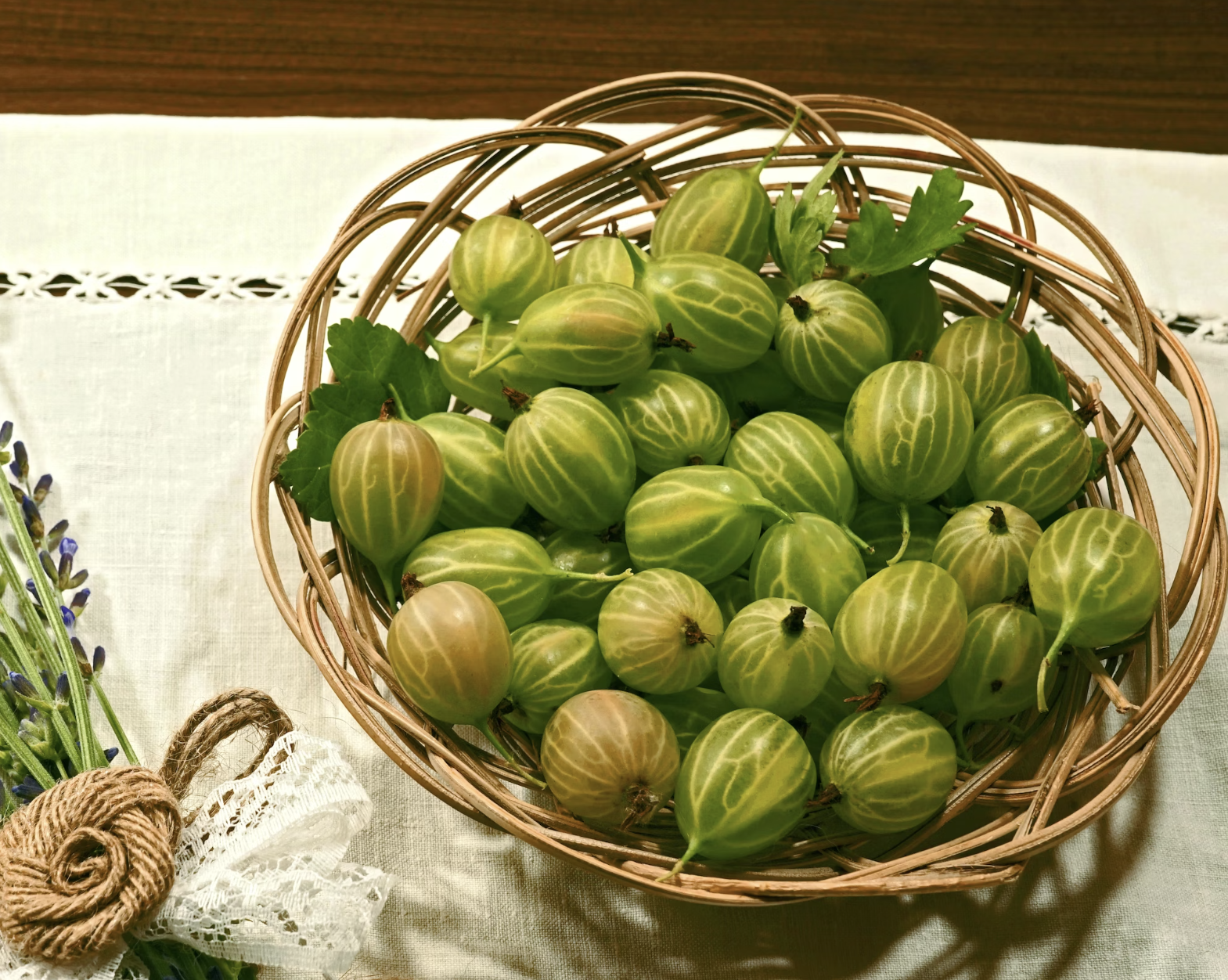
So with all this in mind, I cultivate and nurture this bush outside, which is about 2 foot in height so far. Apparently they take about 2 years before bearing fruit, and even then the yield for the first growing season is low. Hazards to watch out for include fruit fly, including a variety called saw fly, birds with a sweet tooth, and in our case, warring cats.
I will be bringing more seeds back from my next trip (if anyone has a local source, please let me know), and nurturing the next crop sometime soon. If anyone wants to join me in the introduction of this fabulous fruit into Israel (perhaps this could be my contribution to the 60th birthday celebrations), get in touch.
Perhaps peace through gooseberries is too much to hope for, but if you plant a seed, you’ll get first taste of a glorious gooseberry fool 2 seasons hence!
Growers take note:
Gooseberries may be banned as a cultivated species in some places because they’re considered invasive in some areas and may displace native species. They are also an intermediate host of at least one serious disease, white pine blister rust. Cultivation is no longer banned in US states, except for many Maine. They are considered a high value cultivar .
Want more growing joy? Try these 7 healing herbs, growing an olive tree in a pot, or growing a fig tree.



RT @greenprophet An Organic Gooseberry Bush http://bit.ly/W9UJ4
Hello,
I would like to know whether “Hannah Mills” who posted a reply to your column (which I enjoyed also) is THE extraordinarily gifted Hannah Mills who has created calendars in the past. I have looked high and low for her calendar for 5769 but have been unable to locate one. Thanks in advance for your help.
Hi!
When I was a kid in Northern Indiana we had gooseberry bushes that produced delicious fruit nearly every year, with no fertilizing or special care. Grandma made delicious Gooseberry pie (sweetened with sugar of course) most years. Sometimes she mixed strawberries with the gooseberries to make a pie as well. YUM YUM! How could I get my hands on some seeds?
Light Dancing
Gooseberries grew wild where I grew up in Southeastern Missouri. My Grandmother made the very best gooseberry pies. She took them to church gatherings and family reunions. Everyone loved them, including me. I too would like to grow a gooseberry bush. Do you know where I could find one?
Hi Hannha,
thanks for that. I have seen blueberry bushes for sale in Mishtela around Jerusalem: my favourite is Victor’s Nursery on rehov Beitar (ask for Tomer), or Itamar’s Nursery at Moshav Ora (great cafe too).
But I can get some blueberry seeds from the UK to share too…..
About the worms … just keep digging away at a patch of soil; they will come. And a tended compost heap will attract them too, eventually.
I haven’t found wormeries for sale here yet, but there are US and UK companies who would send them – maybe cheaper if a few folk buy together?
Email me at: jamesmurraywhite”at”gmail.com to co-ordinate seed swaps.
james
I live in the northern mountains on the border of Rosh pina-safed and would like give it a try….is the climate here compatible…? jerusalem and nof kinneret (my neighborhood) is similar to the climate of Jerusalem though it tends to be slighly cooler here in winter and i think can get a little hotter here in summer
I am an organic gardener myself..and am presently eating a just picked salad of baby greens which i am growing under a tent of this meshy fabric cloth that lets rain and sun in and keeps cold out somewhat…
I am also very interesting in getting a blueberry bush- do you know if it will grow here…blueberries are one of the highest antioxidant food on the planet and have not seen them in the Land…..
Also you mentioned WORMS for composting. Where can you get them here. In the states, my garden was full of worms but here there is not a one….
Thanks for your reply. Loved your story
Growing organic in nof kinneret
hannha