

 You’ve already read about mulch, rot and the need to invigorate when composting, now that the snow has cleared, it’s time to give the garden and plants and trees some energy and care again.
My compost bin is made from two old wooden pallets, found abandoned on the streets. There are three fixed sides, screwed together, and a fourth wall, which is moved into place as and when. From other bits of the pallet, I made slabs of wood that with the aid of stakes knocked into the earth, when balanced on top of one another, form an internal dividing wall.
This splits the bigger bin into two: one for current compost, the other for compost that I’ve stopped adding to, and other than an occasional random turn with a fork, is being left for however long it takes to completely decompose (or is subject to the whims of my gardening patience, which varies depending on the season and what’s growing).
Knocking this together is so easy, and depending on how fancy you want the bin to be, needs only the pallets, a dozen screws or nails, a hammer and a drill, muscle and elbow grease.
Remember, your plants (and the planet) will thank you.
Right now, the bin is half full. I found the time and motivation the other week to dig out the rotted compost and deliver it to various flowerbeds and potted plants. Some of it is stored for plants to come, and some of it will be added, like a yeast, or activator; to the next batch, which is currently fermenting and gurgling in the other half of the bin.
Learn to love the tiger worm
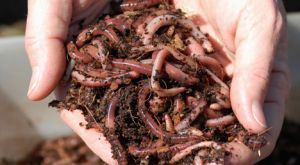
I’ve completely dug the first half out – this is to dry out both the soil and the wood of the pallet.
Also this lets some light into dark places: roots of random plants can grow, and its a good idea to get these out before they get too thick and dominate.
This is also when a gardener gets to see their best buddy, the tiger worm (pictured above). These are the real workers of an active compost heap. They have their subordinates, like the wood louse, or smaller types of worm, and tiny bacteria we can’t see, but it is the trojan tiger worm who really does the hard machinations, chewing and excreting most of the compostable material. Lots of these worms and you are onto a good thing.
Worms and the glorious Middle Eastern sun keep the whole pile rolling. But if you don’t see any don’t give up – firstly, they are shy, and secondly, if you keep providing good green vegetation, they’ll get there. Worms migrate to where the action is.
In the next compost post (see the first one here) I’ll deal with what you can and can’t put into compost.
Basically, you should treat a compost pile like a sandwich – keep adding layers of stuff until you feel it is ready. But more next time. In the meantime, feel free to tell us any compost-related stories, thoughts, or more exciting community composting plans.
Oh, and any questions, fire away! We’re here to help.
See also “Mulch, Rot and Invigorate“




[…] articles on composting: Mulch, Rot and Invigorate the Compost Heap (Part 1) A Half Empty Bin and Some Worms (Part 2) Make Your Own Vegetable Composter for Under $10 AKPC_IDS += "15596,"; […]
Hi James,I have a question. First of all… where is the rest of this series? It looks so helpful. Also – are there any specific and special things one should do when composting in the Middle East. I heard that people in the Middle East should water their bin so that it doesn't dry out. Some people cover it with a carpet and plastic. In Canada keeping it in bin with a wooden lid is enough, but in hotter, dryer places other steps need to be taken. Is this true?-Karin
yes, when the compost becomes like the consistency of soil. take some in your hand and check if its crumbly …. basically, the longer you leave compost, the better it becomes, meaning the more ‘soil-like’.
and yes, the bottom of your compost pile will compost first – thats where the worms etc are working away, and where the heat of the pile is. So that’s why its good to either divide your pile in 2, or have 2 piles. So that you decide when to stop adding to 1 pile, turn it, and just leave it to work.
hope that helps!
Hi James,
Cool post! I was wondering how you can tell when the compost is ready to be used as fertilizer? Also, do the lower levels become ready to be used as fertilizer before the upper levels?
thanks