
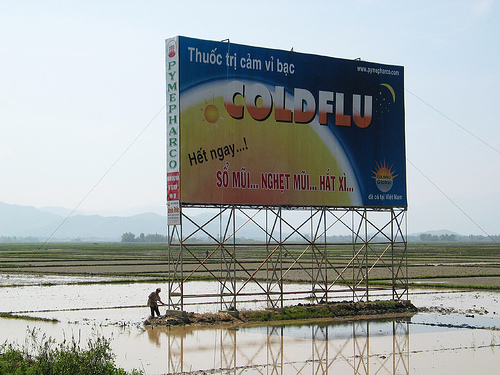

 One of my more vivid childhood memories is of the drive across the George Washington Bridge from New York to New Jersey, and zoning out to stare at what seemed like an endless procession of towering billboards displaying images of shiny cars, shiny models, and shiny promises of success.
Seriously, is there a kid in America who can’t name at least three cigarette brands offhand by the age of 6? We’re not so much aware of the ads as much as they sink in insidiously, becoming an integral part of our landscape.
This insidious manipulation was recently called into question in Israel’s High Court of Justice, by none other than the State Prosecutor’s Office. Green Action (Peula Yeruka) had brought charges against Nur Advertising for posting billboards on the Ayalon Highway. The charges? That the billboards flouted the Road Affixing of Signs Law, damaging the landscape and posing a threat to security.
Acting director of the High Court Dina Zilber wasn’t content to condemn Nur Advertising on legal grounds, however. Instead she fired a round of passionate anti-advertising remarks, based in part on the ideas of Kalle Lasn, Canadian author of the anti-advertising, anti-consumerist book Culture Jam. Zilber pointed out that there is “no escape” from advertising, that it becomes so ubiquitous that its effects are not even consciously noticed.
So Green Action won the case, and the giant billboards are being dismantled as we speak. What makes this case particularly interesting is that it began as a purely environmental issue, with its focus on the effects on the landscape, and later on took on a psychological dimension: what is the effect of such pervasive advertising on the human brain? Does the saturation level of advertising constitute unfair manipulation?
Nur Advertising is protesting bitterly on the grounds of free speech, claiming that it’s ridiculous to insinuate that people are not responsible for their decisions.
So it goes…But in the meantime, the precedent has been set. Maybe the George Washington Bridge is next?
Green Prophet related :: Piggybacking on Tel Aviv’s Billboard Waste :: A Spiritual Danger, Have a Nice Ass? :: Tel Aviv Billboards Up Again, That Didn’t Take Very Long
:: Haaretz



This look interesting,so far.
If there’s anyone else here, let me know.
Oh, and yes I’m a real person LOL.
Later,
Nothing seems to be easier than seeing someone whom you can help but not helping.
I suggest we start giving it a try. Give love to the ones that need it.
God will appreciate it.
Hi,
I was wondering who took the picture of the COLD FLU billboard? I’m in a local band in Tacoma and would like to use it on a CD cover. Was hoping to be able to get permission to keep things on the up and up with the author of that cool picture!
-= Ivan
PS… It’s in the bringing down the billboards on ayalon highway post.
[…] two weeks after advertisers were forced to cover up billboards along Tel Aviv’s Ayalon highway, as a prelude to taking them down altogether, the […]
Make peace, not war!
Not a bad idea. I’ll consult the wife (designist dream woman).
Would it be wrong if I said yes? Also, there is something about a gargantuan milkie that I find irresistible.
Maybe you can make an art installation project based on your billboard fantasies?
Does that mean the three dimensional washing machine with the spinning action is also going to be taken down?
Harry,
Will you miss it?
Excellent news….. & good ridance!