
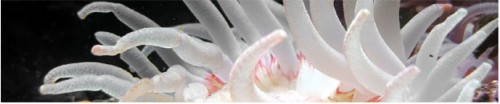


The earth is warming up. There is no doubt about that. And carbon dioxide levels are increasing too. New research from the Hebrew University in Jerusalem and the Carnegie Institution in the US suggests that if things get worse, coral reefs will start to dissolve. That’s millions of years of evolution that will simply melt away. Even if corals can “get sexy on the seafloor” due to effects of greenhouse gases, as we reported earlier, the rise in CO2 might happen too fast for them to cope.
Rising carbon dioxide in the atmosphere and the resulting effects on ocean water are making it increasingly difficult for coral reefs to grow, say scientists.
A study published in Geophysical Research Letters warns that if carbon dioxide reaches double pre-industrial levels, coral reefs can be expected to not just stop growing, but also to begin dissolving all over the world.
The impact on reefs is a consequence of both ocean acidification caused by the absorption of carbon dioxide into seawater and rising water temperatures. Previous studies have shown that rising carbon dioxide will slow coral growth, but this is the first study to show that coral reefs can be expected to start dissolving just about everywhere in just a few decades, unless carbon dioxide emissions are cut deeply and soon.
“Globally, each second, we dump over 1000 tons of carbon dioxide into the atmosphere and, each second, about 300 tons of that carbon dioxide is going into the oceans,” said co-author Ken Caldeira of the Carnegie Institution’s Department of Global Ecology.
“We can say with a high degree of certainty that all of this CO2 will make the oceans more acidic – that is simple chemistry taught to freshman college students.”
The study was designed determine the impact of this acidification on coral reefs.
The research team, consisting of Jacob Silverman, Caldeira, and Long Cao of the Carnegie Institution as well as Boaz Lazar and Jonathan Erez from the Hebrew University, used field data from coral reefs to determine the effects of temperature and water chemistry on coral calcification rates.
Armed with this information, they plugged the data into a computer model that calculated global seawater temperature and chemistry at different atmospheric levels of CO2 ranging from the pre-industrial value of 280 ppm (parts per million) to 750 ppm. The current atmospheric concentration is over 380 ppm, and is rapidly rising due to human-caused emissions, primarily through the burning of fossil fuels.
Based on the model results for more than 9,000 reef locations, the researchers determined that at the highest concentration studied, 750 ppm, acidification of seawater would reduce calcification rates of three quarters of the world’s reefs to less than 20% of pre-industrial rates.
Field studies suggest that at such low rates, coral growth would not be able to keep up with dissolution and other natural as well as manmade destructive processes attacking reefs.
Prospects for reefs are even gloomier when the effects of coral bleaching are included in the model.
Coral bleaching refers to the loss of symbiotic algae that are essential for healthy growth of coral colonies. Bleaching is already a widespread problem, and high temperatures are among the factors known to promote bleaching.
According to their model the researchers calculated that under present conditions 30% of reefs have already undergone bleaching and that at CO2 levels of 560 ppm (twice pre-industrial levels) the combined effects of acidification and bleaching will reduce the calcification rates of all the world’s reefs by 80% or more. This lowered calcification rate will render all reefs vulnerable to dissolution, without even considering other threats to reefs, such as pollution.
“Our fossil-fueled lifestyle is killing off coral reefs,” says Caldeira. “If we don’t change our ways soon, in the next few decades we will destroy what took millions of years to create.”
“Coral reefs may be the canary in the coal mine,” he adds. “Other major pieces of our planet may be similarly threatened because we are using the atmosphere and oceans as dumps for our CO2 pollution.
“We can save the reefs if we decide to treat our planet with the care it deserves. We need to power our economy with technologies that do not dump carbon dioxide into the atmosphere or oceans.”
This week is Earth Day on Thursday. Think of ways you can cut your greenhouse gas emissions, and offset when you can.
More on coral reefs:
Monitoring Stations in the United Arab Emirates Show Stressed Out Coral
Coral Reefs Get Sexy To Cope With Global Warming
Will Coral Reefs At Aqaba Be Destroyed By Litter?
Corals Cope With Rising Sea Temperature By Eating High Protein Jellies
Jellyfish Invade Lebanon
Corals Will Melt If CO2 Levels Double
New Research Ship To Paint Red Sea Green



Green Prophet » Coral Reefs To Melt Away If CO2 Levels Double http://tinyurl.com/yzegekp
Green Prophet » Coral Reefs To Melt Away If CO2 Levels Double http://tinyurl.com/yhv62sv
[…] in giant freezers because it may be too late to save them in situ. we covered it in an article here about how Israeli scientists are contributing to […]
Coral Reefs To Melt Away If CO2 Levels Double http://tinyurl.com/cvyk5o
Coral Reefs To Melt Away If CO2 Levels Double http://ow.ly/3ixi