

The Tel Aviv City Council held a discussion yesterday on a handful of building plans that, if approved, would effectively transform some of the city’s most historic areas beyond recognition.
The discussion, which council members described as “fateful” and “dramatic,” drew a large number of city residents, eager to have a say in the planning of their neighborhoods.
However, the discussion was conducted in a manner that seemed to exclude the public, while avoiding a serious discussion of the city’s future development.
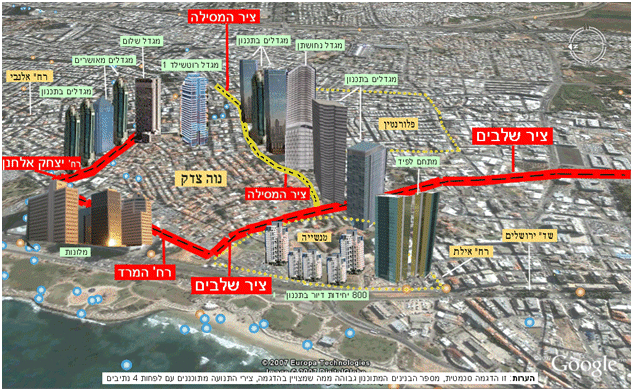
The plans under discussion included the widening of Yitzchak Elchanan Street, north of Neveh Tzedek, as well as the new Mesila Highway, south of the neighborhood.
Both are plans for new roads, lined with skyscrapers, that together would form a ring of traffic and tall buildings around Neveh Tzedek, one of Tel Aviv’s oldest and most charming (and richest) neighborhoods.
When connected with the Shlavim Highway, another highway + tall buildings plan that the city is promoting east of Jaffa, the plans would create a major new traffic artery, channelling cars from the Holon Interchange south of the city to a series of new parking lots along Rothschild Boulevard.
From the beginning, it was obvious that there would be no real and honest discussion at the meeting, which was held to discuss several appeals against the plans submitted by council members.
Instead of being held in the usual City Council hall, the discussion took place in a small meeting room on the 12th floor of the municipality building.
Dozens of residents, refused entry on the grounds that there was not enough space, speculated that the meeting was deliberately held in a small space in order to keep them out.
When they were finally let in, over an hour into the meeting, the residents made their presence felt with catcalls and hearty applause for council members that spoke out in opposition to the plans.
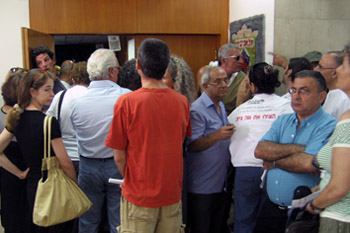 Left: Dozens of angry residents were initially denied entry into the meeting, on the grounds that there was not enough space for the public. (Photo by Jesse Fox)
Opponents of the plans claimed that they would necessitate the destruction of two schools near Neveh Tzedek, form a “separation wall” of concrete buildings between south neighborhoods instead of connecting them and ruin the character of neighborhoods slated for preservation.
The Mesila Highway, a three-story right-of-way (a subway line and an underground highway below street level, with a park on surface) was criticized as unrealistic and unlikely to ever actually take shape.
The plans themselves were only drawn up after a higher planning committee ordered Tel Aviv to formulate a comprehensive planning document, instead of haphazardly promoting a collection of individual building plans and roads, as it had done until then.
The city presented and approved the comprehensive plan recently, resulting in several appeals.
The plan, which was neither printed nor submitted for public review, was only presented halfway through the meeting, on the request of a council member.
Several neighborhood representatives criticized the plan as being superficial, unprofessional and hastily put together. The documents contained no serious discussion, for example, of the effects that the tall buildings would have on breezes, or of where their shadows would fall.
Apparently, no one thought about where all of the new residents’ children would go to school, or what effect their cars would have on the already traffic-clogged area. Some council members pointed out that the new residential buildings, in all likelihood populated largely by foreign residents, would add little to the fabric of life in that part of the city.
Only after the meeting ended did it become clear that someone had actually drawn up an alternative plan, in which the thousands of housing units proposed by the city would be built in low-rise buildings instead of skyscrapers. No one had mentioned this alternative during the meeting itself, although neighborhood representatives had expressed their clear preference for such an alternative.
After all sides’ claims were presented, Deputy Mayor Doron Sapir, who chaired the meeting, declared a closed discussion and asked all observers to leave.
In the end, the plans will probably be approved. That’s the way it is in Tel Aviv – Mayor Ron Huldai demands strict discipline from members of his coalition, and he knows that he can easily find the votes to pass any proposal he likes.
The fact that so many major new roads (accompanied, of course, by parking lots, giant intersections, gas stations, etc.) are being approved in southern Tel Aviv speaks volumes about the city’s planning policy. Increasingly, the mythical light rail, which is still not even close to implementation, is looking like a smoke screen.
The bottom line is that the city backed itself into a corner. By encouraging developers to buy up large plots of land in an area of the city that it thought no one cared about, city planners found themselves with a series of plans for tall buildings in an area where no other building rises above four stories.
By promoting skyscrapers around Neveh Tzedek, the city found itself antagonizing a hornet’s nest of wealthy and well-connected citizens. And by excluding opinionated residents from most of the planning process, the city found itself with an uncompromising front of opposition that no longer believes a single word uttered by its officials.
While the future of the area remains unclear, there is still reason for optimism. Politicians are slow learners, preferring a bitter fight to the end over an agreed-upon compromise. However, a line in the sand has been drawn by residents and activists in the city, and a new kind of politics is slowly taking shape in the city.
More on urban planning in Tel Aviv:
- Tel Aviv Puts Jaffa Skyscraper Plans on Hold
- Coming Soon: A Wall of Skyscrapers Between Tel Aviv and Jaffa?
- Florentine Fights Back
- Tel Aviv Plans Expanded Tayelet – and Shrunken Beach
- Tel Aviv “City Rats” Give New Ideas to Urban Planners
Top image: The future of Neveh Tzedek? A map, prepared by the residents’ committee, illustrating future construction plans. (Image via: www.nevetzedek.org)




I support environmental protection. I participated in demonstrations in Tel Aviv, Herzliya and Ashdod. Not like at all skyscrapers cover the landscape.
yours
נווה
Neve – maybe you can inspire others!
Green Prophet » Citizens Shut Out as Tel Aviv Debates Skyscraper City http://tinyurl.com/ybqyzl6
This reminds me a lot of the fight to stop the Spadina expressway from destroying Toronto’s most unique neighbourhoods in the 1970s (see: http://en.wikipedia.org/wiki/Spadina_Expressway ). The fight, today recognized as a great victory for the people of Toronto and the heritage of the city, was lead by Jane Jacobs, the legendary thinker who literally wrote “the book” on how to build liveable cities (“The Death and Life of Great American Cities”). It took time and a great deal of effort, but not only was the Spadina expressway cancelled, but the entire outlook of the local and provincial governmment was changed and other similar projects were shelved for good.
I hope the brave people fighting this disaster can learn from our success. It seemed impossible at first but with enough determination it wasn’t.
Green Prophet » Citizens Shut Out As Tel Aviv Talks About …: Here in Israel a few months ago we celebrated Yom.. http://bit.ly/MoSmn
[…] Originally published at GreenProphet.com. […]