Adam Teva V’Din and Zalul Push the Plastic Bag Bill

plastic-bags-vietnam-israel

Every day, Israeli stores and supermarkets give away 14 million plastic bags, which is more than twice the size of Israel’s entire population.

While plastic bags may be handy for bringing back food from the shuk or transporting a cold beverage down to the beach, the question is, why do plastic bags have to be a necessity in Israel? Plastic bags require energy and raw materials to produce, they cost businesses money, and they are difficult to dispose of.

In the US, one can dispose of plastic bags at limited locations like Whole Foods markets, but in Israel there is no real way to dispose of the bags. The best case scenario is that the bag is thrown away in a garbage can, in which case it decomposes over many years in a landfill. This reduces landfill space, and causes the plastic to leach toxic chemicals into the soil upon decomposing.

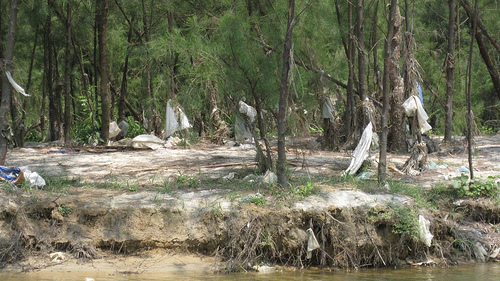
As is often the case, the light plastic bags blow away and find their way to rivers and the ocean. Dozens of dolphins have died from plastic tossed into the Red Sea, and not long ago an autopsy report on a whale that washed up on an Israeli beach indicated that its death resulted from 4.5 kilograms of plastic bags wrapped inside its belly.

There are currently several organizations working to pass bills to limit Israeli plastic bag use: The Israel Union for Environmental Defense (or Adam Teva V’Din) drafted a legislative bill, which is in its first reading at the Knesset. The ‘plastic bags bill’ is pushing the government to ban or discourage plastic bag use because of the environmental ramifications.

The proposed law provides incentives to consumers to reduce their use of plastic bags in the form of a levy of one shekel (roughly 25 US cents) for every plastic bag taken at supermarkets, to be shown as a separate item on their receipt.

Zalul, an Israeli Environmental Association is also working on ways to petition for limiting plastic bag use in Israel, through the promotion of using less plastics, increasing the number of Recycling Bins, and new technology for thin bags that do not require plastic and are able to decompose faster.

Plastic waste and especially the excessive use of plastic bags have posed problems around the world, and hopefully Israel will soon support alternative ways through legislation and through general culture to limit its currently high use of plastic bags.

Marcus Sopher is currently on an internship with Green Prophet for the summer, where he will be investigating Israeli clean technology, specifically research and products in solar energy,

2 COMMENTS
  1. Thanks for posting this! Modi’in was once pushing a law that would abolish plastic bags in the supermarkets – anyone out there know what happened to that idea?

Comments are closed.

Hot this week

How Renewable Energy is Revolutionizing the Way We Power Our World

Solar has become the star of the transition thanks to modular hardware and straightforward installation. It fits dense cities and remote towns alike. Many companies are turning to rooftop arrays and carport systems - and exploring commercial solar installation as a practical way to lock in future savings.

How does one start prepping?

Faced with an extreme winter storm this year, Americans wonder how to be prepared for catastrophe. Miriam has lived through wars in the Middle East - so she's prepared on giving you a guide to prepping.

Fishermen sue tire manufacturers on behalf of the salmon

A federal trial in San Francisco has brought US tire manufacturers, fishing groups, and environmental scientists into court over a chemical most drivers have never heard of — but which scientists say may be silently reshaping aquatic ecosystems.

Listening to Water: Tarek Atoui’s Next Work for Tate Modern

Born in Beirut, Lebanon in 1980 and now living in Paris, Atoui has spent years building instruments that don’t sit comfortably in concert halls. Many of them involve water, glass, and ceramics — materials that react to sound instead of simply producing it.

Leading Through a Dual-Energy Transition: Balancing Decarbonisation with Energy Security

Experience in one area of the energy industry isn't enough to guarantee readiness across all the others. That's where a structured program like an MBA in energy can come in. Today's advanced curricula explore energy economics, finance, policy, and strategic management alongside the technical subjects. And when pursuing an energy MBA online, professionals can skill up and retrain without having to step out of the labor market -- an important perk at a time when skilled professionals are already in short supply.

Topics

How Renewable Energy is Revolutionizing the Way We Power Our World

Solar has become the star of the transition thanks to modular hardware and straightforward installation. It fits dense cities and remote towns alike. Many companies are turning to rooftop arrays and carport systems - and exploring commercial solar installation as a practical way to lock in future savings.

How does one start prepping?

Faced with an extreme winter storm this year, Americans wonder how to be prepared for catastrophe. Miriam has lived through wars in the Middle East - so she's prepared on giving you a guide to prepping.

Fishermen sue tire manufacturers on behalf of the salmon

A federal trial in San Francisco has brought US tire manufacturers, fishing groups, and environmental scientists into court over a chemical most drivers have never heard of — but which scientists say may be silently reshaping aquatic ecosystems.

Listening to Water: Tarek Atoui’s Next Work for Tate Modern

Born in Beirut, Lebanon in 1980 and now living in Paris, Atoui has spent years building instruments that don’t sit comfortably in concert halls. Many of them involve water, glass, and ceramics — materials that react to sound instead of simply producing it.

Leading Through a Dual-Energy Transition: Balancing Decarbonisation with Energy Security

Experience in one area of the energy industry isn't enough to guarantee readiness across all the others. That's where a structured program like an MBA in energy can come in. Today's advanced curricula explore energy economics, finance, policy, and strategic management alongside the technical subjects. And when pursuing an energy MBA online, professionals can skill up and retrain without having to step out of the labor market -- an important perk at a time when skilled professionals are already in short supply.

From Green Energy to Healthy Societies: Why old systems thinking is becoming relevant again

Across the Middle East and North Africa, large investments are being made in green hydrogen, renewable energy, water infrastructure and sustainability. Most of these efforts are discussed in the context of climate change, decarbonization and economic diversification. That framing is important, but it may not capture their full value.

We saw peace – an interreligious encounter deep in our eyes

They came from Israel, Palestine, Jordan, Iraq, Yemen, Morocco, Tunisia, Lebanon, Egypt… There are Sunni Muslims, Shiite Muslims, Jews (Orthodox and Reform), Orthodox Christians, Coptic Christians, Protestant Christians, Druze, Baha'is, a Scientologist.

Can biochar reduce ‘Forever Chemicals’ in food if it’s used in farms?

Biochar is produced by heating organic material in a low-oxygen environment so it does not burn. This process, known as pyrolysis, transforms plant matter into a stable, carbon-rich material.

Related Articles

Popular Categories