
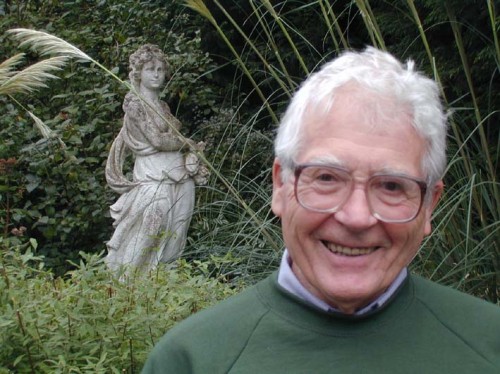


“We became the Earth’s infection a long and uncertain time ago”: James Lovelock is perhaps the world’s best-known independent scientist; he has published a new book, The Vanishing Face of Gaia: A Final Warning.
Lovelock has served humanity and the planet well by inventing a device (the ECD – Electron Capture Detector), which detected the amount of CFC’s in the atmosphere, but he is better known as the founder of the Gaia Principle. In a nutshell, this is the structure in which to see the planet and all that is on and of it, as a living whole, instead of separate parts.
In Lovelock’s own words: “To Golding, Gaia, the goddess who brought order out of chaos, was the appropriate title for a hypothesis about an Earth system that regulated its climate and chemistry so as to sustain habitability.” [Writer William Golding gave Lovelock’s theory, developed in 1965, its name]
The author of 5 books about Gaia, Lovelock, as he approaches the sage-like age of 90, has written his most direct and challenging book yet, subtitled ‘a final warning.’
As the author prepares to take up Richard Branson’s offer of a place upon a Virgin Galactic flight in space, he is at his simplest and most direct in this book; highly critical of European green politics and environmentalism, and offering what he believes are the only solutions for partial human survival through the onslaught of climate change.
“If we fail to curb global heating, the planet could massively and cruelly cull us, in the same merciless way that we have eliminated so many species by changing their environment….”
This is quite a slender volume at just 169 pages, but I had to read it 3 times to get my non-scientific head around some of the science he discusses, and I’m still not sure I understand all of the geoengineering techniques he describes. I am grateful for his clear style, the concise glossary at the end, and for his clear arguments in favour of nuclear energy as the only way humanity can produce enough energy in the future to sustain us at the sort of level we are accustomed to.
I wish that I had an equally clear scientific argument against nuclear energy – my opposition to it remains an instinctive one. In the week that further revelations of near disaster at the Sizewell B nuclear station in the UK came out, surely human error (or deliberate human intent) is the main reason nuclear should not be developed. There are 442 Nuclear power stations worldwide, and these produce 17% of the total electricity consumed. But Lovelock’s rationale compels, as does his evisceration of green politics and luddite scientific thinking.
Flawed Science and Public Perception
Early chapters concentrate upon the politics of science, why he has been seen as such a maverick, and why he believes current scientific and hence International Governmental policy toward the changing climate is flawed:
“Our gravest dangers are not from climate change itself, but indirectly from starvation, competition for space and resources, and tribal war.”
Within chapter 2 ‘the Climate Forecast’, Lovelock presents 3 pieces of scientific evidence that show that predictions of sea level and sea temperature rise, as well as the Arctic ice melt, have been woefully inaccurate – this is levelled at members of the IPCC (Intergovernmental panel on Climate Change, that met recently in Bali), but readers should note that International policies are set on the evidence presented by the IPCC, so this is a clarion call for more rigorous examination of all the evidence available – from all the scientists out in the field, or the sea, or on the polar ice caps.
What I hear from Lovelock is that it might be better to start with the worst-case scenario.
“But it is wrong to think that nothing can happen rapidly in climate change. Aerosols in the atmosphere, snow and ice albedo [the amount of sunlight reflected by a planetary surface], ecosystem response, and of course human response – any of these can cause a perceptible climate change within months.”
He continues that he is wary of “speculations to assuage the fear of the dark clouds that loom on the climate horizon.”
I greatly admire Lovelock as a pragmatic thinker, who criticises the policymakers who set policy often based on theory alone, or flimsy evidence. While there is an element of ‘if they had listened to me 30 years ago’, he does come to terms with why many fellow scientists have ignored or even belittled his theory. He is justifiably angry with the introspection and reticence of many scientists whom he says:
“Seem less inclined to test our ideas in the real world and we no longer seek the judgement of nature, preferring the judgement of our peers.”
This may be due partly to C.P Snow’s famous prophecy in his Cambridge 1959 lecture ‘The Two Cultures’ as quoted by Lovelock that Britain’s intellectual life has become polarised between science and the humanities, and the ‘public intellectuals’ from the arts have won.
Adaptation & smart thinking on energy use
“The humanists have been victorious, and the credibility and character of scientists and engineers has been downgraded.”
Lovelock developed the Daisyworld computer modelling system in 1981 – this act seemed to save his theory, and take it to an entirely new level.
Gaia has now been adapted and expanded by Lovelock and others (do also read this review of Stephan Harding’s wonderful book ‘Animate Earth’ to gain more knowledge about Gaia theory), and is starting to make more sense to the hardnosed ‘single track’ scientists.
How we can adapt and change our own mindset to understand the process of climate change within the framework of Gaia is the core of Lovebook’s book, and what he comes back to time and again in ‘The Vanishing face of Gaia’.
He is clear about the imperative need for humans to adapt to the changing situation: namely use land more wisely, by curbing urban sprawl and save land for agriculture, develop foods that can be synthesised – “food synthesis would lessen its impact upon the planet” – (if Quorn was the only food available, I personally would walk the land armed with a hunting knife…), and hope (or pray) that some geoengineering techniques could buy us more time.
These include physical acts, such as manipulating the planetary albedo; biological, such as tree planting and preservation, and ocean seeding; and tweaking Gaian geoengineering to use the ecosystem to power the process. I was fascinated to learn that the eruption of the Pinatubo volcano in 1991 injected 20 million tons of sulphur dioxide into the stratosphere.
According to Lovelock, “atmospheric global warming appeared to halt for the next 3 years.” There are some really radical proposals suggested in these pages, and while he presents (to my mind) sound science to support these ideas, we are entering the realm of Hollywood when we envisage humanity carrying out some of them.
Human obligation
“In the latter part of the 20th Century the green movement was largely on the political left. Then a slow recognition that capitalism seemed to work better than most forms of socialism, hastened by the collapse of soviet communism in Russia and Europe, moved green thinking on to a liberal humanist high ground that saw the threat to the Earth mostly in terms of the immediate consequences for the welfare of people.
“There was still no realization that ultimately harm to the Earth system, Gaia, was more serious than harm to humanity.”
Lovelock is deeply critical of a European-led green political movement that has, in his eyes, put human survival over the destruction of habitat.
He traces its roots, and applauds some of the specific campaigns, including CND (Campaign for Nuclear Disarmament), but says we got the focus wrong in those early days, which has morphed into a knee-jerk green reaction against the necessary progress.
Lovelock spits out bile at the wind turbines which now spill out across the British countryside, including near his home in Devon – describing them as a “new icon” which seem to “mock the cross.”
There is a lot here in this slim volume to digest and investigate further. Lovelock has stirred up passions with his critique of the green movement, and inflamed many with his passionate support for nuclear energy.
By developing Gaia, Lovelock has given humanity a wider framework to see ourselves within, both physically, systemically and spiritually. This great gift of understanding makes me regard Lovelock as a sage for this troubled and complex age, and I amongst many will be saluting as he sets foot upon the Virgin Galactic, ready to view this burning planet from above.
“The disease that afflicts the Earth is not just climate change – manifest by drought, heat and an ever-rising sea. Added to this there is the changing chemistry of the air and the oceans, and the way the sea grows acidic.
“Then there is the shortage of food for all consumers of the animal kingdom. As important is the loss of that vital biodiversity that enables the working of an ecosystem. All these affect the working of the Earth’s operating system and are the consequences of too many people.”




[…] The Vanishing Face of Gaia, by James Lovelock AKPC_IDS += "15269,";Browse topics: book review, recycling […]
I wonder if Dr. Lovelock knows about the prospects of electromagnetic energy (aka Zero Point Energy or Vacuum Space Energy). If so, I would like to know what he thinks. If not, I wish somebody would tell him about it. Find out more at http://www.orionproject.org,
I presume Lovelock believes in intelligent design. If he believed in evolution he would not attach a purpose to life, or particular forms of life.
As a lay person, to help get your head around nuclear a bit better you might try this site: RadDecision.blogspot.com . I’m a nuke worker in the US and have written a novel that illustrates both daily life in a nuclear plant (one kind anyway) and how an accident might proceed. I cover both good and bad – I’m not sold on any energy source myself, I just want the discussion to be a rational one. (Stewart Brand, founder of ‘The Whole Earth Catalog’, seemed to like it.)