



Etihad Airways from the United Arab Emirates has signed an agreement with Masdar (the same group developing the world’s first carbon neutral city), to reduce the carbon footprint of the airline. The company follows in the footsteps (or wings?) of two other Middle East airline projects we know about — one in Israel to green the country’s airport, and another more tangible project in Qatar. Today let’s focus on Qatar:
Qatar Airways, whose innovative advertisements are seen often on international news media programs such as CNN, is the first Middle East airlines to become involved in a plan that will enforce the reduction of greenhouse gas-causing carbon dioxide emissions by launching a carbon offsetting scheme for passengers.
The company just announced signing a “ground-breaking agreement with the International Air Transport Association (IATA) to spearhead the global carbon offset trading scheme designed to help fund global environmental projects,” reports the Peninsula.
The plan, as announced by Sheikh Akbar Al Baker, the company’s CEO, calculates the carbon “footprint” for each flight, and then asks airline customers who purchase tickets online to contribute towards projects which will offset the carbon emissions caused by each flight.
The plan, endorsed in an agreement with the international air carrier organization IATA, will invest these contributions in community environmental protection projects such as alternative energy, reducing noise, recycling of waste products, and other environmentally friendly endeavours that will reduce the dangers of global warming. The airline will also invest in cleaner and more efficient aircraft to keep carbon emissions at a minimum.
Making the airline more environmentally friendly is part of Sheikh Baker’s Social Responsibility Plan for Qatar Airways which has created the “Five Pillar Corporate Social Responsibility Strategy” which deals with matters of change management, environment, integrated fuel management, communication, and sustainable development.
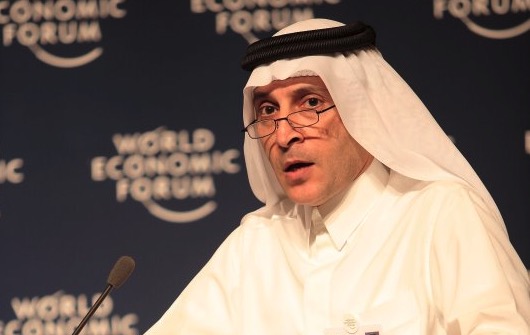
Al Baker believes that the airline must go beyond the current aviation industry standards for fuel and environmental management in order to assure a qualitative and competitive future for the company. His plan also entails ensuring a better future for the airline’s staff as well as for the world “neighborhood” in which they live:
“We have the responsibility to deal with the impact on global climate change, noise, local air quality, non-renewable resources and waste” he said.
Qatar Airways’ fleet aims to be one of the cleanest and most fuel efficient in the industry. By getting airline passengers involved in helping the environment, Al Baker feels that they will appreciate being a part of an overall effort to offset the problems of global warming and climate change.
“It goes without saying that our children’s future depends on the responsible actions of Qatar Airways, its peers, other industries, and you, the passenger,” he added.
More on green flying from the Middle East:
Join The Great Airways Debate Part I
The Great Airways Debate Part II
Will Tel Aviv Airport Be First Middle East Airport To Fly Green?




[…] I guess we will have to wait for more results to assess the impact and value of these two initiatives. In the meantime, you can read about the carbon offset kiosk pilot project at the San Francisco airport. […]
[…] into the atmosphere. To mitigate the aviation industry’s future environmental impact, Boeing, Etihad Airways and the Masdar Institute of Technology are working on a groundbreaking new jet fuel made […]
[…] Middle East’s major carriers, such as Etihad and Qatar Airways, have undertaken to reduce aviation emissions from their ground operations and in flight (in […]
[…] Carbon offsetting is still a relatively unknown concept in Saudi Arabia but a few foreign carbon offset companies have stated to speed up their marketing efforts in the Kingdom. While I am all for conserving the ecosphere, I think it makes sense to question the relevance and feasibility of offsets in the kingdom. Many experts now believe that the offset model comes with its own set of challenges and it will be interesting to see how these manifest in the Saudi context. Here are my arguments for why I think it won’t work: […]
[…] by $2 million of Etihad funding, this ground-breaking R&D lab is pioneering use of salt water-tolerant plants in […]
[…] Etihad spokesperson said: “Etihad Airways remains opposed to this scheme. We consider it to be more an anti-competitive tax on non-European […]
[…] that in the short run, it is unlikely to have a dramatic effect on carries carriers such as Etihad Airways (working to cut greenhouse gases), Emirates Airlines and Qatar Airways (see Green Prophet’s past story on Qatar Airway’s […]
[…] these institutions and organizations like Masdar, Boeing, Etihad Airways, and Honeywell continue to fund and execute great sustainability projects like the items above, […]
[…] Etihad Airways’ Chief Executive Officer, James Hogan said, “The development of carbon-neutral sources of energy is of major importance to Etihad Airways and the aviation industry. We are delighted to be a key member of the Sustainable Bioenergy Research Project which will be based in Abu Dhabi and will be one of the most innovative schemes of this nature in the world.” […]
[…] new biofuel project to power commercial airliners, including large ones such as Airbus. Not long ago Etihad Airways from Qatar already pledged its aim to reduce greenhouse […]
hello i have a ask on singapore airlines
singapore airlines is a take off from israel????
hello,iam have a small Ask:
qatar and etihad,is take off from israel,or not?
send me the answer to:
[email protected] Thx
Etihad Airways Joins Qatar Airways In Bid To Cut Greenhouse Gas Emissions http://bit.ly/fLVsy
Etihad Airways Joins Qatar Airways In Bid To Cut Greenhouse Gas Emissions http://bit.ly/fLVsy
Etihad Airways Joins Qatar Airways In Bid To Cut Greenhouse Gas Emissions http://tinyurl.com/dh3b9o
Etihad Airways Joins Qatar Airways In Bid To Cut Greenhouse Gas Emissions http://ow.ly/3ef2
[…] I guess we will have to wait for more results to assess the impact and value of these two initiatives. In the meantime, you can read about the carbon offset kiosk pilot project at the San Francisco airport. […]