EcoBaladi Sprouts Organic Vegetables From the West Bank Valley of Thorns (Wadi Fuqin)

 abu-ibrahim organic eco-baladi farm west bank palestinian
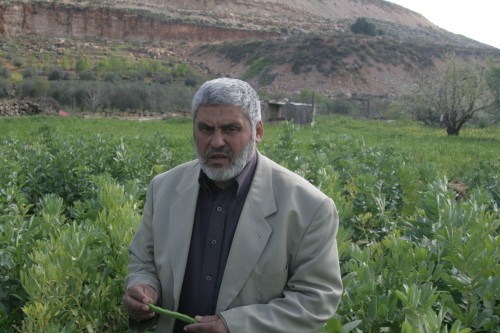
(Abu Ibrahim, 53, in a field of fava beans. Photo: Daniella Cheslow)

One of the most compelling parts of the West Bank is its Biblical landscape, shaped by the small villages and terraced farm plots that dot the rolling hillsides.

Yesterday, I saw that landscape up close on a visit to Wadi Fuqin (Valley of Thorns) a village of about 1,200 southwest of Jerusalem nestled in a valley under the brow of the apartment blocks of the neighboring Beitar Illit settlement. The 100 village farmers use old and new techniques to raise chemical-free vegetables for themselves, for Bethlehemites and for idealistic Jewish residents of neighboring Tzur Hadassah, Jerusalem and Tel Aviv through the EcoBaladi Web site.

Haaretz writer Ronit Vered recently waxed poetic about Wadi Fuqin here.

My host was Abu Ibrahim, 53, a school teacher who helps his 73-year-old father farm about 5 dunams (1.25 acres) on the valley floor. Abu Ibrahim has a wife and eight children. He speaks some English and bits and pieces of Hebrew. I got in touch with him through an Israeli woman who had ordered vegetables from him.


beitarfuqin abu-ibrahim organic eco-baladi farm west bank palestinian

Olive trees in Wadi Fuqin’s fields; Beitar Illit in the distance (all photos by Daniella Cheslow).

Getting to the valley requires either a private car, in which you can ride from Jerusalem out towards Gush Etziyon and Beitar Illit, or you can take a Palestinian bus from Jerusalem to either Bethlehem or Gilo Junction and from there, take a cab.

The village is small enough that on the ride in, my cab driver simply asked people where Abu Ibrahim lived. When we couldn’t find his house, the driver asked a village boy to jump in the car and help us out, and he happily obliged.

The homes in the built-up area of the village ascended a steep incline traversed by risky asphalt roads. The farmland, all in the flatter valley, was divided into tiny patches; green wheat grew on one and knee-high cabbages bloomed on a miniscule square.

The bright green tendrils of snow peas sprang up between the cabbages and the onions. Further afield were fava beans, and at the edge of another small square were the tall leaves of the beetroot. Olive and almond trees were mainly on the edges of the farmland.

I was interested in seeing the traditional ways of farming being used in the fields; while some plots were traversed by black drip irrigation pipes, others were dug to take advantage of the lay of the land. For example, there was a square, full water reservoir in the fields. At its base was a channel dug of earth. Water from the reservoir flows into the channel and onto the patch of cabbages.

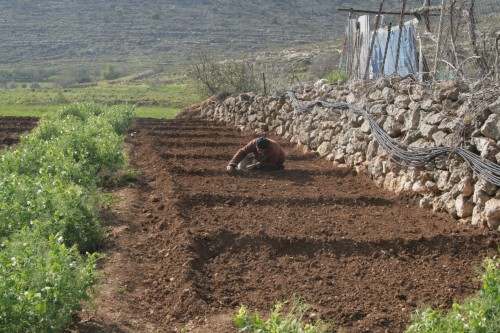
A little lower on the hill was a chain of square dirt plots separated by raised lines of earth; Abu Ibrahim said that as the top square fills with water, he breaks the barrier to let the water flow to the next one.

reservoir-channel1

The water reservoir; water flows out the hole at the bottom and down the earthen channel to the fields below.
onion terrace abu-ibrahim organic eco-baladi farm west bank palestinian

Abu Ibrahim’s father, 73,  planting onions in the beds that descend the hillside. Planting this way helps direct water from plot to plot, downhill.

Abu Ibrahim said that because the crops are first grown for local consumption, the farmers are careful not to use chemicals. He said this helps him command a premium in Bethlehem markets, and among Israelis. At the same time, there was a bottle of Spanish weed killer resting between the plots; he said that helped get rid of the weeds that grow so high that it is impossible to plow with his donkey.

abuibrahim abu-ibrahim organic eco-baladi farm west bank palestinian

Abu Ibrahim picking lemons from his backyard tree.

At his own home, Abu Ibrahim grows vegetables in a greenhouse and lemons on a few trees in the backyard. Under his and his family’s homes are a chicken coop; he said the chickens sleep indoors at night and peck around the backyard during the day. In another pen, goats and sheep bleated.

sheep abu-ibrahim organic eco-baladi farm west bank palestinian

One of Abu Ibrahim’s sheep.

Wadi Fuqin’s future is unsure. As I learned when I visited last year, the village is wedged between the Green Line on one side and Beitar Illit on the other. The villagers claim that sewage from Beitar Illit is contaminating the eleven springs that historically have provided for local water needs. The prospect of the security barrier being built is a constant presence; the Green Line runs right through the valley.

map abu-ibrahim organic eco-baladi farm west bank palestinian
Map of the area. Wadi Fuqin is southwest of Jerusalem, the brown smudge just north of the blue area of Beitar Illit. Map taken from Btselem.org.

If you are interested in ordering vegetables from Wadi Fuqin, check out www.EcoBaladi.com.

Daniella Cheslow
Daniella Cheslowhttp://www.greenprophet.com
Daniella Cheslow grew up in a car-dependent suburb in New Jersey, where she noticed strip malls and Wal-Marts slowly replacing farmland. Her introduction to nature came through hiking trips in Israel. As a counselor for a freshman backpacking program at Northwestern University, Daniella noticed that Americans outdoors seemed to need to arm themselves with performance clothing, specialized water bottles and sophisticated camping silverware. This made her think about how to interact with and enjoy nature simply. This year, Daniella is getting a Master’s in Geography from Ben Gurion University of the Negev. She also freelance writes, photographs and podcasts. In her free time, she takes day trips in the desert, drops off compost and cooks local foods like stuffed zucchini, kubbeh and majadara. Daniella gets her peak oil anxiety from James Howard Kunstler and her organic food dreams from Michael Pollan. Read more at her blog, TheTruthHerzl.com. Daniella can be reached at daniella (at) greenprophet (dot) com.
4 COMMENTS

LEAVE A REPLY

Please enter your comment!
Please enter your name here

TRENDING

Astro uses AI to help procure land for renewable energy

For oil-rich, environmentally vigilant Gulf states, Astro isn’t just another startup story. It is a blueprint for accelerating an energy transition that is now existential, not optional.

Sink holes from over-watering farmers’ fields

Sinkholes are rapidly appearing in Turkey’s central Anatolian farming region, particularly around Konya and Karapınar. These giant gaping holes in the ground in areas of farmland, known locally as obruk, are not random geological events. They are linked to prolonged drought, climate-driven heat stress, and heavy groundwater extraction for agriculture in one of the country’s most important breadbaskets.

Oil pollution in Basrah’s soil is 1,200% higher than it should be

Soil pollution levels in parts of Basra are 1,200% to 3,300% higher than those typically measured in cities like Toronto or New York, according to new comparative soil data. It's getting into water.

Peace hospital opens between Jordan and Israel

The proposed medical centre, described by Emek HaMaayanot Regional Council head Itamar Matiash as “a centre for cancer treatment, so that people from Jordan or further away could come and receive treatment,” would become the flagship of a wider cluster of medical, academic and innovation-based services planned for the Israeli half of the zone.

Travel Morocco with teens at the Kasbah du Toubkal’s magical mountain retreat

Walking well-trodden mountain pathways, eating fresh local food, and learning about the transformative work embedded in the Kasbah’s approach to tourism has now been imparted to our children. We hope, in turn, these experiences will serve to inform their contributions in the world as they continue to grow. Don’t wait, Morocco is on everyone’s bucket list. Growth and change are inevitable. 

Qatar’s climate hypocrisy rides the London Underground

Qatar remains a master of doublethink—burning gas by the megaton while selling “sustainability” to a world desperate for clean air. Wake up from your slumber people.

How Quality of Hire Shapes Modern Recruitment

A 2024 survey by Deloitte found that 76% of talent leaders now consider long-term retention and workforce contribution among their most important hiring success metrics—far surpassing time-to-fill or cost-per-hire. As the expectations for new hires deepen, companies must also confront the inherent challenges in redefining and accurately measuring hiring quality.

8 Team-Building Exercises to Start the Week Off 

Team building to change the world! The best renewable energy companies are ones that function.

Thank you, LinkedIn — and what your Jobs on the Rise report means for sustainable careers

While “green jobs” aren’t always labeled as such, many of the fastest-growing roles are directly enabling the energy transition, climate resilience, and lower-carbon systems: Number one on their list is Artificial Intelligence engineers. But what does that mean? Vibe coding Claude? 

Somali pirates steal oil tankers

The pirates often stage their heists out of Somalia, a lawless country, with a weak central government that is grappling with a violent Islamist insurgency. Using speedboats that swarm the targets, the machine-gun-toting pirates take control of merchant ships and then hold the vessels, crew and cargo for ransom.

Leopoldo Alejandro Betancourt López Turned Ocean Plastic Into Profitable Sunglasses

Few fashion accessories carry the environmental burden of sunglasses. Most frames are constructed from petroleum-based plastics and acrylic polymers that linger in landfills for centuries, shedding microplastics into soil and waterways long after they've been discarded. Leopoldo Alejandro Betancourt López, president of the Spanish eyewear brand Hawkers, saw this problem differently than most industry executives.

Why Dr. Tony Jacob Sees Texas Business Egos as Warning Signs

Everything's bigger in Texas. Except business egos.  Dr. Tony Jacob figured...

Israel and America Sign Renewable Energy Cooperation Deal

Other announcements made at the conference include the Timna Renewable Energy Park, which will be a center for R&D, and the AORA Solar Thermal Module at Kibbutz Samar, the world's first commercial hybrid solar gas-turbine power plant that is already nearing completion. Solel Solar Systems announced it was beginning construction of a 50 MW solar field in Lebrija, Spain, and Brightsource Energy made a pre-conference announcement that it had inked the world's largest solar deal to date with Southern California Edison (SCE).

Related Articles

Popular Categories