


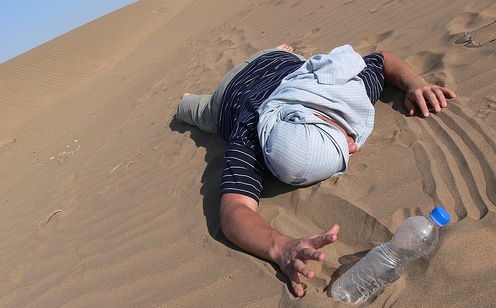
As if to add to their current misery, the 1.5 million inhabitants of the Gaza Strip are now facing an acute water shortage due to ground water contamination. These findings were made in a research project recently conducted by three Gaza academics: Dr. Ziad Abu Hein, head of Environment and Earth Sciences Department at the Islamic University in Gaza, Dr. Khalil Tbeil, lecturer at the Faculty of Agriculture at Al-Azhar University in Gaza, and Dr Midhat Abu An-Na’im, of the Geology Department at Al-Azhar University.
The three scientists published their findings in a research paper which received an award at a competition sponsored by the Saudi government’s Sultan Bin Abdul-Aziz research competition and submitted to a conference on water conservation being held in Egypt, where the paper won a third place award.
The three scientists were not allowed to attend the conference, however due to the blockade being imposed on Gaza by both Egypt and Israel.
Prior to the January 2006 Gaza elections, in which the Hamas religious and political organization assumed power in the Strip, a substantial portion of Gaza’s water supplies was supplied by Israel, along with electricity and other needed services. Following the virtual seizure of complete control over Gaza by Hamas, and the continuous launching of rockets and mortar shells into Israel, the Israeli government has literally sealed off the Strip, except for sporadic deliveries of basic humanitarian aid.
Both water and electricity supplies have been suspended, leaving the Gazans to fend for themselves, by bringing in needed goods and supplies through a series of underground tunnels.
The problem of adequate fresh water supplies, now only available by digging wells in the ground water aquifer of the northern Gaza Strip, has been jeopardized due to pollution from sea water, fertilizers (particularly nitrates), and sewage.
Gaza does not have the financial resources to construct large desalination plants like the one in operation in the Israeli city of Ashkelon, only a few kilometers up the coast. When the plant was constructed, a portion of the desalinated water was to be piped into Gaza; but that is no longer possible, due to current political and security realities.
Should any kind of political solution ever be possible between Israel and Gaza, a joint effort to deal with the acute water shortage in the Strip might be made by the construction of at least two desalination plants there with Israeli assistance.
Two facilities the size of the one in Ashkelon (which supplies Israel with approximately 6% of its total fresh water needs) would go along way towards alleviating Gaza’s water crises. This could be paid for by the development of the large natural gas field which is situated in the eastern Mediterranean off the Gaza coastline, with part of the gas being traded to Israel for fresh water (including that from the Israel national water carrier) and electricity from Israel’s national grid.
Gaza has one of the highest population densities in the world, and with an average family having 6 to 8 children, Gaza’s population is expected to increase significantly in the next 20 years.
But without any changes in the current state of affairs between Gaza and Israel, the water crises in the Strip will become even more acute in the years ahead. It might be interesting to note that the same researchers, who won this recent award, also won first place in same competition last year for a research work dealing with hydrology and water sources.
As to what could be accomplished if these three academics could have the possibility to work together with their Israeli counterparts in the same field; they might not only help solve Gaza’s long term water problems, but those in other parts of the region as well, including other water starved countries like Jordan and even Egypt.
More on Middle East water:
Water Crisis In The West Bank
Solar Air Conditioning Apparatus Squeezes Water From Thin Air
Israel’s Water Levels Go From Red To Black
[image via selmanpinarli]


[…] Water shortages are a widespread and common problem for the people of the Gaza Strip. There just isn’t enough water for the growing population and an Israeli blockade which limits imports and exports means the locals can do little to alleviate the situation. I recently wrote about the stunning water mural project in the Gaza Strip which highlights the serious water shortages in the area in the hope of encouraging political action. The EU also recently pledged 10 million euros for a desalination plant that would serve Khan Yunis and Rafah. Until these projects can have the desired effect, however, farming on the land in Gaza has become almost impossible. […]
[…] along with local artists, teachers and school children got together to paint 8 murals exploring the water struggles of the Gaza Strip. Murals were painted on the walls of elementary schools and near water desalination units in areas […]
The Gaza water crisis – acute shortage and groundwater pollution
http://tiny.cc/OwCSQ
Water Relationship Possibilities Between Israel and Gazans In Better Days http://ow.ly/1tCN
[…] leave a comment » Read Green Prophet. […]