Saudi Oil Minister Calls Renewable Energy a "Nightmare"

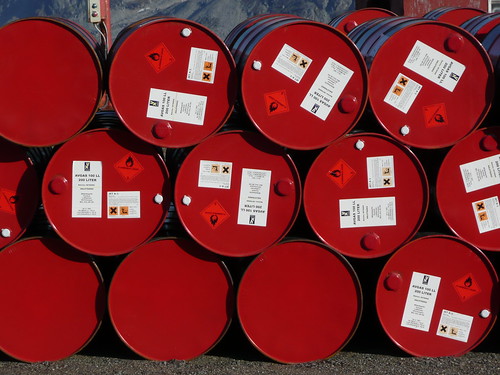
oil drums saudi arabia photo

This week, executives of major oil companies met at the Cambridge Energy Research Associates (CERA) annual conference in Houston, Texas and (finally!) expressed a willingness to help combat global climate change.  This is a major step, because these companies denied the existence of global warming and deliberately tried to obstruct political progress on the issue for decades.

Unfortunately, not everyone was equally supportive of transitioning to a renewable energy economy.  In a speech to conference participants, Saudi Arabia’s Oil Minister Ali Naimi warned that promoting the rapid growth of renewable energy without continuing to invest in oil would create a “nightmare scenario.”

“We must be mindful that efforts to rapidly promote alternatives could have a ‘chilling effect’ on investment in the oil sector,” he said. “A nightmare scenario would be created if alternative energy supplies fail to meet overly optimistic expectations, while traditional energy suppliers scale back investment.”

Although Mr. Naimi, an influential voice in the Organization of Petroleum Exporting Countries (OPEC), acknowledged that the world is moving away from fossil fuels, he indicated renewable energy technologies may be unable to grow to the same scale as crude oil.

He called the current energy infrastucture “highly efficient and economical,” and said the costs of replacing it with alternatives would be “prohibitive” in the short term. “A prudent approach demands we recognize that the massive scale of the global energy system makes rapid change costly and impractical,” he said.

At the Poznan climate talks last year, Wael Hmaidan of the Arab Climate Alliance commented that oil wealthy countries, especially Saudi Arabia, rely on the world’s oil dependence as a source of political power, so they act to obstruct or diminish the political will for clean, renewable energy.

The timing of Mr. Naimi’s statement strikes me as suspicious, and seem to confirm Mr. Hmaidan’s conclusions.  Crude oil prices are very low, surely affecting the economies of oil-producing nations (many of which are right here in the Middle East).  OPEC members have even postponed 35 oil-production projects in development because oil prices are so low.  Meanwhile, the new Obama administration has already signaled its commitment to renewable energy and to both domestic and international climate mitigation, which will likely further diminish both the profits and political bargaining chips of oil-rich nations.

All of these facts leave me wondering whether Mr. Naimi’s remarks reflect a genuine concern for the health of the global economy, or a continuation of the international power politics and individual greed that imperil our climate and the future of our world.

:: Environmental Capital – WSJ

Image: Ezioman

For more on renewable energy in the Middle East:
Even Oil Rich Gulf Countries Look to Renewable Energy
Israel, Egypt & Abu Dhabi All Set Renewable Energy Goals

Masdar “Zero Carbon” Super City Breaks Ground This Month in Abu Dhabi


Rachel Bergstein
Rachel Bergsteinhttps://www.greenprophet.com/
When her vegan summer camp counselor explained to a fifteen-year-old Rachel how the dairy industry pollutes the groundwater in poor rural communities and causes global warming, there was no turning back. Her green fire lit, Rachel became increasingly passionate about the relationship between human societies and the natural environment, particularly about the systemic injustices associated with environmental degradation. After snagging a B.A. in Peace and Justice Studies at the University of Maryland, where she wrote an undergraduate thesis on water injustice in Israel/Palestine and South Africa, Rachel was awarded the New Israel Fund/Shatil’s Rabbi Richard J. Israel Social Justice Fellowship to come and spread the green gospel in Israel for the 2009-2010 academic year. She currently interns for Friends of the Earth Middle East in their Tel Aviv office. When Rachel is not having anxiety about her ecological footprint, carbon and otherwise, she can be found in hot pursuit of the best vegetarian food Tel Aviv has to offer. She also blogs about her experience as an NIF fellow and environmentalist in Israel at organichummus.wordpress.com. Rachel can be reached at rachelbergstein (at) gmail (dot) com.
6 COMMENTS
  1. I beleive that “Renewable Energy” is the call of time. Saudi Minister must propose alternatives rather than resisting change.

  2. The Oil supply constraints in the last 5 years were caused by a sharp shortfall in investment back in the late 1990’s. Mr. Naimi was simply warning against such under-investment that may lead to even worse oil shocks in the future.

    What a cheap shot!

Comments are closed.

TRENDING

Should You Invest in the Private Market?

startustartup Unlike public stock exchanges, which offer daily trading, strict...

What are AWG air-water generators, and why they aren’t a golden-bullet solution (yet)

Atmospheric water generators (AWGs) sound like magic: machines that can pull drinking water out of air. The idea is mentioned in the Bible, where the elders would pray for water collected as dew on plants and the catch on turning this into a machine is in the physics. To turn invisible vapor into liquid, you must remove heat, especially the latent heat of condensation.

Jordan’s $6 Billion Aqaba–Amman Desalination Project from the Red Sea Moves Forward

In 2025, the Jordanian government signed agreements with a consortium led by Meridiam and SUEZ, alongside VINCI Construction and Orascom Construction. Under a 30-year concession agreement, the consortium will design, build, finance, operate, and maintain the system before transferring it back to the Jordanian government. The total investment is estimated at approximately $6 billion USD.

Saudi Arabia cancels the Asian games at Neom’s Trojena

Neom, a bombastic collection of futuristic cities and resorts, has flopped as Saudi oil prices roll back reality. The Saudi plan of hosting the 2029 Asian games to be held at Trojena, a ski report in the desert, has been cancelled. 

Xcimer is the Denver-based startup that could put Saudi Arabia out of business

An American company can collapse OPEC if they can prove their approach to unlimited energy works.

Should You Invest in the Private Market?

startustartup Unlike public stock exchanges, which offer daily trading, strict...

How to build a 100-year-company

Kongō Gumi is a Japanese construction company, purportedly founded in 578 A.D., making it the world's oldest documented company. What can we learn about building sustainable businesses from them?

From Pilot Plant to Global Stage: How Aduro Clean Technologies’ 2026 Expansion Signals a Turning Point for Chemical Recycling Investors Like Yazan Al Homsi

The company's Next Generation Process (NGP) Pilot Plant in London, Ontario, has officially moved into initial operating campaigns, generating the kind of structured, repeatable data that separates laboratory promise from commercial viability.

How AI Helps SaaS Companies Reduce Repetitive Customer Support Work

SaaS products are designed for large numbers of users with different levels of experience, and also in renewable energy.

Pulling Water from the Air

Faced with water shortage in Amman, Laurie digs up...

Turning Your Energy Consultancy into an LLC: 4 Legal Steps for Founders in Texas

If you are starting a renewable energy business in Texas, learn how to start an LLC by the books.

Tracking the Impacts of a Hydroelectric Dam Along the Tigris River

For the next two months, I'll be taking a break from my usual Green Prophet posts to report on a transnational environmental issue: the Ilısu Dam currently under construction in Turkey, and the ways it will transform life along the Tigris River.

6 Payment Processors With the Fastest Onboarding for SMBs

Get your SMB up and running fast with these 6 payment processors. Compare the quickest onboarding options to start accepting customer payments without delay.

Related Articles

Popular Categories