

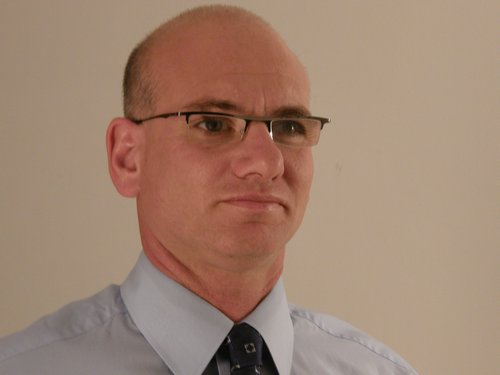
This interview features Eyal Hadas, managing director and head of renewable energy at Cukierman & Co. Investment House Ltd. (CIH) in Tel Aviv.
We met Eyal at a renewable energy conference at Tel Aviv University several months ago (when Al Gore was in town and Karen photo-ed him in his cowboy boots), and were impressed by his experience in the international clean technologies market.
Israeli companies have some strengths and limitations, says Eyal who has worked for years in Europe. He will explain more below.
For those interested in understanding the Israeli market a little better, Eyal offers some food for thought. I was particularly surprised to find out that Persian Gulf countries are already investing in Israeli clean technologies.
First – more about Cukierman: Founded in 1993, Cukierman is the leading European oriented investment house, headquartered in Israel. They provide a full array of investment banking services including corporate finance, private equity and strategic consulting to Israeli and European companies.
Since its establishment, Cukierman has been engaged in transactions valued at €2.36 billion through private placements, initial public offerings and mergers and acquisitions. In addition, Cukierman has developed a dominant position in private equity through the Catalyst Fund.
Eyal, tell us a little about Cukierman, who it invests in, and how the organization is positioned to other investment banks in Israel, Europe: We are investment bankers based out of Tel Aviv, with an office in Paris. In general, we either act as principals through our private equity fund, Catalyst ($100 million under management) or as advisors in various transactions: $10 million to $100 million. Examples: IPOs, private & public placement, merger and acquisition, corporate & project (structural) financing.
We have several verticals division: Real-Estate IT, Bio-Technology & Energy.
We work regularly with all the major Israeli financial institutions for example IBI – Poalim Capital Markets, UNION Bank and institutional investors, and also in Europe. We are also the representatives of the Government of Hong Kong and of Dews, Switzerland. His firm also works abroad and if you are looking to expand to Hong Kong for instance, see HK tax advisors.
Tell us what you do specifically: The Energy Division of Cukierman focuses primarily on financial advisory transactions backed by cash flow generating assets in renewable energy, mostly in the EU. We have been involved so far in wind, biogas and photovoltaics (PV). These transactions provide annual yields to the investor of 10 percent and upwards, depending on various factors, such as the technology type and geographical location.
CIH Energy functions as a “one-stop-shop” for its clients: due diligence, financial, legal & tax advisory services. In the course of our business, we have developed alliances with some of the leading renewable energy companies in Europe, who are projects developers, financial institutions, technology and engineering due-diligences services, legal and tax advisors.
What kinds of unique opportunities do you see here in Israel’s clean technology sector? Israel as a “technology development hub” is however, by in large, a rather small (“niche”) market for cleantech technologies:
1) Renewable Energy: energy storage, photovoltaic (PV) panels efficiency improvement
2) Water Treatment: biological (drinking water & wastewater Purification, “Water Safety”
3) Solid & Liquid Waste Treatment: biological biodegradable technologies primarily for hazardous waste treatment.
What do you think are the companies’ strengths, the hottest enterprises? Do you have any favorite companies? Israeli companies, which are most innovative normally, manage to develop a “cutting-edge technology” outside the box, so to speak. Due to a small market size they can hardly bring their products and service to the local market – to “scale it up’” Nor are Israeli clean tech companies capable of strategic marketing (usually the case).
Has your company invested in any Israeli ventures? If so, which ones? Our private equity fund, Catalyst, hasn’t made an investment in cleantech ventures in Israeli companies. However, suitable investments (annual company turnover of at least $5 million are being considered).
Some are saying that renewable energy might be the only way to stop global warming. What’s your position on that? It’s an unrealistic view! Renewable energy will provide a substantial contribution. More importantly from the perspective of global warming is energy saving and efficiency measures!
Can you envision other Middle East countries investing in Israeli clean technologies in the near future, or is it a preposterous idea? Yes. Actually Persian Golf countries are already investing in Israeli cleantech ventures either directly (via companies in Cyprus for example) or through USA / European Private Equity Funds.
Can you offer any tips for young entrepreneurs who might want to apply to Cukierman for investment or counsel? Study the needs and the prices of your target market/s well!
How does your model work? We first screen, then due diligence the technology/products/service/ company (including its management), then we deicide if we will take an exclusive mandate (normally a retainer Euro 3,000-5,000 per month + success-fee of about 2.5 – 5 percent).
Do you have any environmental heroes? Please share them with us. Yes, several. For example, Dieter Ammer, chairman of the Management Board of Conergy AG, Hamburg Germany. Dieter managed to take –– within 10 years – Conergy from a “start up” of less than $1 million revenues in 1998, to one of the largest renewable energy systems and projects providers worldwide: in 2007 there were Euro 706 million in revenues.



[…] With Sun Power for Desalination Plants Private Equity Firm Buys Up Waste Management Firms in Egypt Cukierman & Co. Investment House Talks Green Investment Shop for Middle East AKPC_IDS += "16899,";Browse topics: Abu Dhabi, clean tech investing, green investing, Masdar […]
Hi Eyal, I do not find your phone number.Erez Dolev