

It's Possible to Harvest More Crop Per Drop, Find Israeli Cleantech Researchers

improved irrigation genetically modifying plant rootsA new solution addresses the problem of water loss and promises farmers “more crop per drop”

A part of the global food crisis is the inefficiency of current irrigation methods. More irrigated water evaporates than reaches the roots of crops, amounting to an enormous waste of water and energy.

Tel Aviv University researchers, however, are investigating a new solution that turns the problem upside-down, getting to the root of the issue. They are genetically modifying plants’ root systems to improve their ability to find the water essential to their survival.

The Root Cause of Wasting Water

When it comes to water, every drop counts. “Improving water uptake by irrigated crops is very important,” says Prof. Amram Eshel, the study’s co-researcher from Tel Aviv University’s Plant Sciences Department. His team, with that of Prof. Hillel Fromm, hope to engineer a plant that takes advantage of a newly discovered gene that controls hydrotropism, a plant’s ability to send its roots towards water.

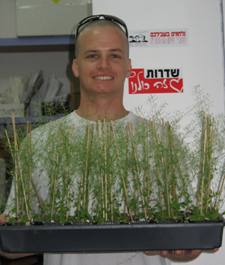
Scientists in TAU’s lab are observing plants that are grown on moist air in the University’s lab, making it possible to investigate how the modified plant roots orient themselves towards water. Until now, aeroponics (a method of growing plants in air and mist) was a benchtop technique used only in small-scale applications. The current research is being done on the experimental model plant Arabidopsis, a small flowering plant related to cabbage and mustard.

Environmental Consequences Have Economic Consequences Too

“Our aim is to save water,” explains Prof. Eshel. “We are increasing a plant’s efficiency for water uptake. Plants that can sense water in a better fashion will be higher in economic value in the future.”

There can be significant water-saving consequences for farmers around the world. “We are developing plants that are more efficient in sensing water,” says research doctoral student Tal Sherman, who is working under Prof. Amram Eshel and Prof. Hillel Fromm. The project is funded by a grant from the Israeli Ministry of Agriculture and Rural Development to Prof. Fromm and Prof. Eshel.

Ideas Planted in Darwin’s Time

In the nineteenth century, scientists were already observing that plant roots naturally seek out the wetter regions in soil.

Although the phenomenon is well documented, scientists until recently had no clue as to how the mechanism worked, or how to make it better. New insights from the Tel Aviv University study could lead to plants that are super water seekers, say researchers.

The groundbreaking research at Tel Aviv University was conducted at the Sarah Racine Root Research Laboratory, the first large-scale aeroponics lab in the world. The Racine lab was founded 20 years ago by Prof. Yoav Waisel through a donation from the Racine family of Israel. Today it is the largest laboratory of its kind.

Prof. Eshel’s team is working on a number of other projects to save the planet’s resources. For example, they are currently investigating the use of a latex-producing shrub, Euphoria tirucalii, which can be grown easily in the desert, as a source for biofuel.

More Water Security stories on Green Prophet:
6 Tips for Saving Water in the Middle East
Chaschams Water Saving Devices Go Door to Door


Read More

1 COMMENT

TRENDING

Regenerative Wool or Greenwashing? Zentera Responds to Critics

Zentera responds to questions about ZQ wool, animal welfare, regenerative farming, ethical fashion and the fallout from PETA's New Zealand investigation.

Tanner Winterhof on the Custom Harvesters Quietly Holding American Agriculture Together

In late January, in a Des Moines hotel ballroom that smelled faintly of diesel and convention coffee, Tanner Winterhof spent three days hosting the members and attendees of the  U.S. Custom Harvesters Inc. annual convention on his podcast as Farm4Profit’s official media partner for the show.

Collecting kinetic energy from roads; REPS turns traffic into a power plant

REPS announced a $23.6M equity financing round to scale...

Baby teeth read like tree rings paint a picture of toxins in early life

A new study from the Icahn School of Medicine at Mount Sinai in New York offers a striking insight into how the environments we are born into can quietly shape our brains years later. By analyzing naturally shed baby teeth, the ones tucked under pillows for the tooth fairy, researchers have reconstructed a detailed timeline of exposure to environmental metals during pregnancy and early infancy.

Saving Gourmet Wild Plants For The Future

Think of truffles, a gourmet wild food. The European...

Locals From Rishon Fight IKEA

Big Box stores are a pretty new concept in Israel, and thank God that not every Israeli city wants them in their backyard. A word from someone who has see the beautiful farmland around her hometown Newmarket, Ontario stripped and converted into vulgar strip malls of big box shops: they have no place in a healthy and sustainable town or city.

The Jewish National Fund Meets An Inconvenient Truth

According to the JNF, it has transformed thousands of acres of barren land into green forests in Israel. They state that each person emits about 23 tons of carbon per year, estimating that each tree planted can absorb one ton of carbon in its lifetime. That's a whole lot of trees you'd need to be planting. Could so many fit in Israel?

How to quiet noise from construction in your office

Streets need to be resurfaced in New York but the humming and grinding noise is unsettling. Noise is environmental pollution. 

EarthX and a blueprint for sustainable investing

Trammell S. Crow, a Dallas-based businessman and father of four, is focusing his efforts on impact investing, and media that focuses on saving the planet through EarthX.

Mining Afghanistan’s Mineral Discoveries Similar to Avatar

Now that American forces in Afghanistan are commemorating the longest period of any war that America has been involved in, including the 1965-73 Vietnam War, the recent discoveries of large and extremely valuable mineral and metal deposits may finally bring to light a reason to continue the presence of US fighting forces in this war torn and backward country.

From Pilot Plant to Global Stage: How Aduro Clean Technologies’ 2026 Expansion Signals a Turning Point for Chemical Recycling Investors Like Yazan Al Homsi

The company's Next Generation Process (NGP) Pilot Plant in London, Ontario, has officially moved into initial operating campaigns, generating the kind of structured, repeatable data that separates laboratory promise from commercial viability.

Nobul’s Regan McGee on Shareholder Value: “Complacency Is the Silent Killer” 

Why the governance framework designed to protect shareholders so...

Should You Invest in the Private Market?

startustartup Unlike public stock exchanges, which offer daily trading, strict...

Popular Categories