

It's Possible to Harvest More Crop Per Drop, Find Israeli Cleantech Researchers

improved irrigation genetically modifying plant rootsA new solution addresses the problem of water loss and promises farmers “more crop per drop”

A part of the global food crisis is the inefficiency of current irrigation methods. More irrigated water evaporates than reaches the roots of crops, amounting to an enormous waste of water and energy.

Tel Aviv University researchers, however, are investigating a new solution that turns the problem upside-down, getting to the root of the issue. They are genetically modifying plants’ root systems to improve their ability to find the water essential to their survival.

The Root Cause of Wasting Water

When it comes to water, every drop counts. “Improving water uptake by irrigated crops is very important,” says Prof. Amram Eshel, the study’s co-researcher from Tel Aviv University’s Plant Sciences Department. His team, with that of Prof. Hillel Fromm, hope to engineer a plant that takes advantage of a newly discovered gene that controls hydrotropism, a plant’s ability to send its roots towards water.

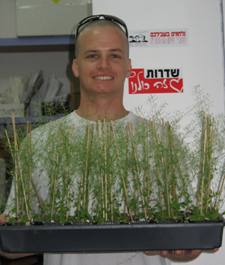
Scientists in TAU’s lab are observing plants that are grown on moist air in the University’s lab, making it possible to investigate how the modified plant roots orient themselves towards water. Until now, aeroponics (a method of growing plants in air and mist) was a benchtop technique used only in small-scale applications. The current research is being done on the experimental model plant Arabidopsis, a small flowering plant related to cabbage and mustard.

Environmental Consequences Have Economic Consequences Too

“Our aim is to save water,” explains Prof. Eshel. “We are increasing a plant’s efficiency for water uptake. Plants that can sense water in a better fashion will be higher in economic value in the future.”

There can be significant water-saving consequences for farmers around the world. “We are developing plants that are more efficient in sensing water,” says research doctoral student Tal Sherman, who is working under Prof. Amram Eshel and Prof. Hillel Fromm. The project is funded by a grant from the Israeli Ministry of Agriculture and Rural Development to Prof. Fromm and Prof. Eshel.

Ideas Planted in Darwin’s Time

In the nineteenth century, scientists were already observing that plant roots naturally seek out the wetter regions in soil.

Although the phenomenon is well documented, scientists until recently had no clue as to how the mechanism worked, or how to make it better. New insights from the Tel Aviv University study could lead to plants that are super water seekers, say researchers.

The groundbreaking research at Tel Aviv University was conducted at the Sarah Racine Root Research Laboratory, the first large-scale aeroponics lab in the world. The Racine lab was founded 20 years ago by Prof. Yoav Waisel through a donation from the Racine family of Israel. Today it is the largest laboratory of its kind.

Prof. Eshel’s team is working on a number of other projects to save the planet’s resources. For example, they are currently investigating the use of a latex-producing shrub, Euphoria tirucalii, which can be grown easily in the desert, as a source for biofuel.

More Water Security stories on Green Prophet:
6 Tips for Saving Water in the Middle East
Chaschams Water Saving Devices Go Door to Door


1 COMMENT

LEAVE A REPLY

Please enter your comment!
Please enter your name here

TRENDING

Astro uses AI to help procure land for renewable energy

For oil-rich, environmentally vigilant Gulf states, Astro isn’t just another startup story. It is a blueprint for accelerating an energy transition that is now existential, not optional.

Farm To Table Israel Connects People To The Land

Farm To Table Israel is transforming the traditional dining experience into a hands-on journey.

Huge Fish Nursery Discovered Under Freezing Arctic Seas

In 2019, an underwater robot camera exploring the seabed...

Iran’s holiest city about to run dry as terror chosen over water management

Iran’s second-largest city, Mashhad, is facing an acute water emergency after dam reservoirs feeding the city fell below three percent capacity, according to Iranian state and local media. Officials warn that without rainfall or improved inflows from neighboring Afghanistan, the city’s supply could soon collapse.

The UAE and sovereign wealth funds for green tech 2025 – get the report

The UAE is positioning itself as the Middle East’s green finance hub — mobilizing billions in sustainable bonds, ESG funds, and innovation capital to support its Net Zero 2050 vision. Green Prophet’s UAE Green Finance 2025 Report explores how banks, investors, and policymakers are shaping the next cleantech frontier, from Masdar City to Abu Dhabi’s sovereign initiatives.

6 Payment Processors With the Fastest Onboarding for SMBs

Get your SMB up and running fast with these 6 payment processors. Compare the quickest onboarding options to start accepting customer payments without delay.

Qatar’s climate hypocrisy rides the London Underground

Qatar remains a master of doublethink—burning gas by the megaton while selling “sustainability” to a world desperate for clean air. Wake up from your slumber people.

How Quality of Hire Shapes Modern Recruitment

A 2024 survey by Deloitte found that 76% of talent leaders now consider long-term retention and workforce contribution among their most important hiring success metrics—far surpassing time-to-fill or cost-per-hire. As the expectations for new hires deepen, companies must also confront the inherent challenges in redefining and accurately measuring hiring quality.

8 Team-Building Exercises to Start the Week Off 

Team building to change the world! The best renewable energy companies are ones that function.

Thank you, LinkedIn — and what your Jobs on the Rise report means for sustainable careers

While “green jobs” aren’t always labeled as such, many of the fastest-growing roles are directly enabling the energy transition, climate resilience, and lower-carbon systems: Number one on their list is Artificial Intelligence engineers. But what does that mean? Vibe coding Claude? 

Somali pirates steal oil tankers

The pirates often stage their heists out of Somalia, a lawless country, with a weak central government that is grappling with a violent Islamist insurgency. Using speedboats that swarm the targets, the machine-gun-toting pirates take control of merchant ships and then hold the vessels, crew and cargo for ransom.

Leopoldo Alejandro Betancourt López Turned Ocean Plastic Into Profitable Sunglasses

Few fashion accessories carry the environmental burden of sunglasses. Most frames are constructed from petroleum-based plastics and acrylic polymers that linger in landfills for centuries, shedding microplastics into soil and waterways long after they've been discarded. Leopoldo Alejandro Betancourt López, president of the Spanish eyewear brand Hawkers, saw this problem differently than most industry executives.

Why Dr. Tony Jacob Sees Texas Business Egos as Warning Signs

Everything's bigger in Texas. Except business egos.  Dr. Tony Jacob figured...

Related Articles

Popular Categories