
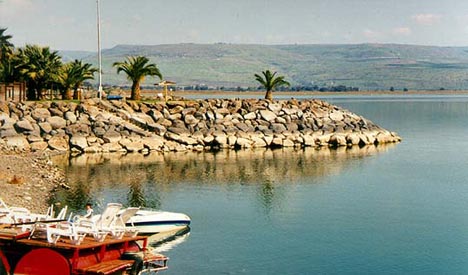

 Every Israeli knows what the Sea of Galilee’s (a main source of Israel’s drinking water) red line means. It’s bad. It means Israel is running out of water and we’re all in trouble. So when the Israel Water Authority came out with a campaign about two weeks ago saying that Israel’s water levels were deteriorating from the red line to the black line, that was even scarier.
To make matters worse, last week the Director of the Water Authority announced that Israel is currently facing the worst water supply crisis in 80 years, ever since they started keeping records. And that unless our water consumption patterns (which have increased in disproportionate levels to our population increase) and water purification methods change… it’s bad news all around.
So what do the red and black lines actually mean?
 Well, the cautionary red line – which is 213 meters below sea level – is the line below which it is not recommended to draw water. The black line (which is black and scary for good reason) is 215 meters below sea level and at that point water really, REALLY can’t be drawn anymore or permanent damage will be caused to the water source.
Scary as it may be, however, the Water Authority‘s website explains what can be done during this time of crisis. A combination of increasing water supply (through desalination and other projects) and decreasing personal water consumption is what they’re asking Israel’s public to be more aware of.
And now that they’ve got your attention, they’re telling you exactly what you need to do in order to do your part.
Their statistics show that the average Israeli person consumes 160 liters of water per day. 35% of this is from flushing the toilet, 35% from bathing, 20% from drinking, cooking, dish washing, 5% from laundry and cleaning, and 5% from gardening. So the most obvious thing to do is reduce your consumption where it counts – flushing the toilet and bathing. Especially bathing – every minute in the shower equals about 20 liters, so make those showers quick or shower with a friend!
For some Green Prophet advice on how to reduce your water consumption and raise the water level lines (hopefully to some happy color, like purple) check out:: Help Save Water in the Kinneret in One Easy Step, Use a Bucket, Think Twice About Water, Is Your Shower Efficient? and Washing Dishes.



[…] This coming Monday, March 22nd will be International Water Day, a time (almost like New Years) for countries to reflect upon their last year of water usage and make resolutions for the year to come. This is especially important in the Middle East, where water is frighteningly scarce. […]
I wrote a story on the impending Israeli water crisis for the Jerusalem Report, which came out at the end of June. What shocked me was that the Israeli water crisis is actually a regular event, one that happens around once every 7-10 years. Government reports dating back to the 1960s issue the same dire warnings and recommendations – less water to municipal gardens, reducing domestic demand, increasing agricultural efficiency – and yet in 2008 we are in dire straits.
Ironically, Israelis use more water per capita than Germans, who live along an abundant river and enjoy regular rainfall. The Water Authority spokesman attributes to a 2- or 3-shower day.
What I cannot understand is why a PR campaign like this one is not coupled with a painful price policy, to ratchet up the price on domestic water use, dry out private pools, and stop the growing of irrigated flowers for export in the Negev. There are price changes in discussion – but they will only take effect in January. Instead, this is a campaign with no enforcement, paired with massive funding for new desalinization plants to help Israelis keep their wasteful habits.
Here’s the article: http://www.jpost.com/servlet/Satellite?apage=1&cid=1212041489034&pagename=JPost%2FJPArticle%2FShowFull
what about all the private swimming pools? go to google earth and you can see nearly one on every other house in cesarea. a slap in the face to flushing the toilet, more like a kick in the butt.
Every time I have had to venture to TA I saw these signs in north TA on the bridges and what are they surrounded by, beautiful green lawns, kind of a slap in the face really. Our local authorities still do not seem to understand the concept of leading by example.
tell the moatza now why are they still watering useless swathes of grass past 8 am? and what about all those private swimming pools, you can see how many there are in google earth, and there are loads in cesarea, nearly every other house.
unfortunately, as a gardener, I’m reducing the water I give to my plants – and this year I’m planting less. and…also using recycled water from the sink and from the shower (though I realise that few will do this). One important thing we can do is encourage friends, family & neighbours (like mine here in Jerusalem) not to water in the daytime – this wastes the water that is too precious to waste. Find ways to cajole and persuade – watering between the hours of 8a.m and 8p.m in the Middle East wastes at least 60% of the water, and damages the plants which struggle to drink in the heat, and get burnt by water on the leaf surface. hope these points help the campaign!
[…] Read more: Israel’s Water Levels Go From Red to Black | Green Prophet […]