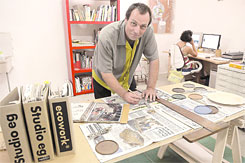
From creating the world’s most popular puzzle website (and a Time Magazine top 50), Israeli-British entrepreneur and hightech whiz Gideon Greenspan decided to change gears and put a focus on the environment.
A couple of years ago, Gideon (who is based in Tel Aviv) was looking for a way to offset his travel and was confronted with a maze of possibilities in the online environment. A master of invention, Gideon’s wheels started turning: he decided to build his own user-friendly directory that offered an independent and balanced rating system. Today he is helping people make sense of all the carbon offset options, and wildly varying prices per ton of CO2e, through his project Carbon Catalog.
He also runs a blog, Carbon Catablog, a repository of insider news and interviews.
Today Gideon talks with Green Prophet about how the Carbon Catalog idea started, where we’re headed and how Israel, in particular, can lighten the carbon load on our planet.
Can you tell us a little bit about you and your background?
I’m originally from the UK and moved to Israel in 2000. By trade I’m an Internet entrepreneur – my creations include Websudoku.com, the world’s most popular puzzle website, and Copyscape.com, a search engine for plagiarism. I’m also involved in a number of Israeli startup companies.
I’ve always been aware of green issues. One thing I like about the software business is that you can create a lot of economic value while consuming (relatively) few natural resources. But I’m no “tree hugger” and my approach is pragmatic rather than ideological. The environmental steps we take in the coming decades will have a large effect on the quality of life for generations of humans to come
Can you tell us about Carbon Catalog and your rationale for starting the project?
As your readers probably know, carbon offsets allow you to neutralize your carbon emissions, by funding an equal reduction in emissions somewhere in the world. A year or two ago I started buying offsets for myself, and found the process to be extremely frustrating.
While there were tons of providers selling offsets online, I wanted a central repository of information that compared and contrasted the providers, so I could make an informed choice about where to buy.
Eventually I decided to solve the problem myself, and created Carbon Catalog. Carbon Catalog is a directory of carbon offset providers and the projects that they support. The listings are continuously updated based on the information on each provider’s website. Carbon Catalog also rates providers based on their transparency and the quality of their projects.
But there’s also an entrepreneurial angle. Depending on what happens in the UN, and in America’s corridors of power, the next decade could see massive growth in the carbon markets, and I’m positioning Carbon Catalog to take advantage of that. But this is for the longer term – for now, I’m focused on providing a non-commercial service for voluntary offset buyers.
What makes Carbon Catalog different from any other resource out there, ie carbon footprint calculators?
Carbon Catalog’s goal is provide an objective and transparent source of information, without any interest or agenda. In other words, it makes no difference to us whether you buy offsets, how many you buy, and who you buy them from. This is unlike most carbon offsetting sites, whose end goal is to encourage you to make a purchase.
Do you think carbon offsets can be an important intermediate step for curbing climate change?
It depends what you mean by carbon offsets. If you mean voluntary offsets, of the sort that are currently purchased by a small number of individuals and companies, then the answer is sadly no. While they do a good job of increasing awareness and encouraging innovation, they will never be a serious part of the solution, because the volume is too small.
On the other hand, if you mean the kind of carbon market that would be created if the world’s politicians and statesmen were brave and principled enough, then it’s a very different matter. While the voluntary market is nibbling at the edges, widespread international regulation would enable the dual problems of climate change and fossil fuel dependency to be tackled head on. Whether we like it or not, money and economics – not words and aspirations – are going to make the crucial difference.
Who are the players most likely to drive the carbon offsets market?
Without a doubt it’s politicians. There is a vast amount of financial and human capital poised to participate in an international carbon trading system. But everything depends on policy and regulation being in place.
Can you give us some examples of ways people in the Middle East can offset, or some steps they can do to lighten their impact?
In this part of the world we’re cursed (and blessed) with abundant heat and sunlight. This means lots of air conditioning, leading to high electricity demand during peak day hours. So a simple step is to turn down our air conditioning, and make sure windows and doors are closed. But the flipside is the huge potential for solar electricity generation. This could both serve local needs, and then be exported to the wider world.
Some say the market could explode to $1 trillion by 2020 in the US alone. Any ideas about what Israel is doing or could do in this market?
On a global scale, Israel’s energy consumption and carbon emissions are very small, so I don’t think it will be a significant source of carbon projects. Rather, I think Israel’s main role will be in research and development. Israel already has a lot of experience in solar energy, and its culture of entrepreneurship and innovation should enable it to expand rapidly into other related areas.
What is carbon financing and how can an Israeli or company in the region get carbon financed? Israel and its neighboring countries could be viewed as “developing” countries. How could prospective projects get certified for providing offsets? Is it a difficult process?
[I combined these two questions]
Carbon financing is the method by which a project which leads to reduced carbon emissions can receive funding from a company or entity which is seeking to offset its emissions. It’s needed by projects which are not economically viable in and of themselves.
The best way to get carbon financed is to work with a company which specializes in developing and reselling carbon credits. In Israel the two main players seem to be Elysium and EcoTraders.
Experts say that if the cataclysmic effects of climate change happen, further instability and violence in the region would ensue. How would you respond to that?
It is undoubtedly a concern – environmental degradation tends to exacerbate conflicts which are lying just below the surface. In the case of Israel and its neighbors, the most pressing issue is water. If climate change leads to less rain and more evaporation, it will become even harder to satisfy the water needs of all the populations in the region.
Maybe if more people offset in this volatile region, ie in the Palestinian Authority, it could help bring stability to the region. Is this so? We understand that “educational” projects can also be construed as carbon offsetting by some standards. If so, how could people in the region connect to the financing for their projects?
There are some offset providers who consider education as part of their offsetting portfolio. However I’m fairly skeptical about this, since it’s impossible to predict or measure the carbon reductions that result from these activities. I’m not saying they are a bad thing, but I don’t think they can play a serious role in a carbon portfolio.
Do you think it’s important for people flying to Israel to offset? If yes, any recommendations?
Of course, it’s a great idea for people flying anywhere to offset their emissions! As for a recommendation, I can’t suggest better than checking out the listings at Carbon Catalog, to find a suitable provider.
In a way the KKL is the world’s first carbon offset organization by planting millions of trees in the Land of Israel. Would you agree?
Well, I don’t know if it was the first organization in the world to support tree planting, but it is interesting how issues of deforestation have gained renewed urgency in the context of climate change. It is estimated that 20-25% of global carbon emissions come from burning and cutting down trees. That is almost as much as is generated by the world’s cars, trucks and buses.
Some say that treeplanting is not the most effective way for offsetting. Why? What do you think is the best way to offset?
Yes, many people question the effectiveness of tree planting as a means to offset carbon emissions. Most offsets based on reforestation look 50 to 100 years ahead when calculating their reduction in carbon emissions. In other words, if you pay to offset a tonne of carbon dioxide from a reforestation project today, it will take up to a century for this tonne of carbon dioxide to actually be absorbed.
What’s more, if the trees are burnt or chopped down at some time in the future, all of the carbon they absorbed will simply be re-emitted into the atmosphere, leading to a net zero effect. By contrast, most other offset projects look no more than 10 or 20 years ahead, and this strikes me as a more realistic basis for calculating reduced carbon emissions.
I believe the best offsets are those which lead to long-term reductions in the burning of fossil fuels. This primarily means investing in electricity generation from renewal sources. Once a solar panel, wind tower, or hydropower station is built, it can generate clear power continuously for many decades. Cheap and clean electricity will also encourage us to run our cars off the power grid, rather than fossil fuels.
Thank you, Gideon.