

Here is the first in the summer season of Green Prophet ‘eco-reads festival’: environment-focussed books , some sharp and caustic, some funny or fact-filled, all written to get us thinking and working for the earth. Over the next month or so, a new review will go live each week, written by a diverse group of International writer/reviewers (all with an Israel connection) all with a passionate connection to the land in some way.

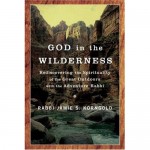
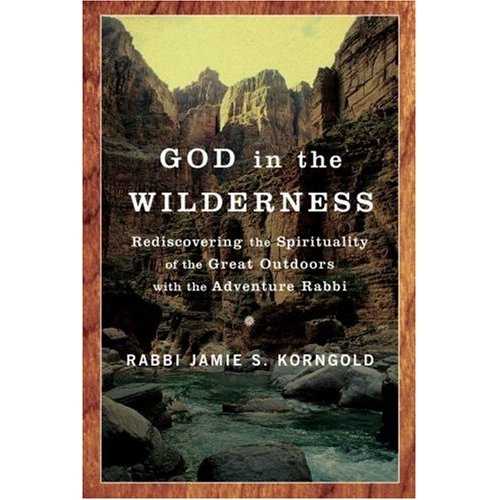
Review of ‘God in the Wilderness’ by Rabbi Jamie Korngold
Review by Ahron Shapiro
Rabbi Jamie Korngold is the Adventure Rabbi. Let me get that out of the way straight away. She is a Triathlon athlete and expert skier. She is charismatic, and she guides an ever-growing community of like-minded Jews. Why it is necessary to attach the Adventure Rabbi moniker to Rabbi Korngold is a question that gets to the heart of the story behind ‘God in the Wilderness: Rediscovering the Spirituality of the Great Outdoors with the Adventure Rabbi.’ The book serves as a spiritual trail map for those who might identify with this form of Jewish practice.
“Adventure Rabbi” is more than Rabbi Korngold. It is something of an umbrella organization for the communities she serves. It may be more accurate, then, to consider Rabbi Korngold herself the Adventure Rebbe. Some of the Rebbe’s first “hassidim” are mentioned in the introduction of the book. Those disciples were Williams College students, unaffiliated and disenfranchised American Jews who felt passionately about nature, outdoor sports and the environment but had trouble connecting with conventional Judaism. In Rabbi Korngold, a Reform rabbi, they found a religious teacher that showed them a side of Judaism that they never knew existed. It was a Judaism that could be practiced outdoors, with minimal use of traditional prayers, few regulations and limitations.
Rabbi Korngold can be a rabbi for Jews like these who don’t feel a spiritual connection in a synagogue. For these Jews, the only rabbi suitable for them is an Adventure Rabbi.
This book, first and foremost, is there for them.
God in the Wilderness raises some interesting points. A powerful observation by Rabbi Korngold is that communication between man and God as mentioned in the Bible most often occurred in nature. She argues that Judaism was first practiced outdoors and was only moved indoors with the advent of the Tabernacle and the Temple in Jerusalem. The book is at its best when it challenges, through citations and sources, the conventional belief that Judaism must be practiced in the confines of a synagogue. These surprisingly brief sections of the book tantalize the reader with glimpses into what the book might have been had they been expanded upon.
With humor and wit, concise and easy to digest, “God in the Wilderness” chapters read like good sermons. The book is best enjoyed by people without a knowledgeable Jewish background. That Rabbi Korngold felt a need to explain to the readers that the Book of Psalms is actually originally a Jewish text that also is used in Christian liturgy says a lot. This book, while a good and interesting read for a wide variety of readers, offers only superficial substance for religiously educated Jews.
Rabbi Korngold overstates the level of detachment of observant Jews from nature. While it is true that American Jewish life has always revolved around the synagogue, and their communities are centered around urban and suburban areas, the author has forgotten the summer Catskills culture among Jews – once ubiquitous but today confined to mainly Orthodox Jews – that have always sought refuge in nature and continue to do so.
Moreover, what is mysteriously absent in the book is any reference to the Israeli Jewish lifestyle which, from the secular all the way to the ultra-Orthodox, has always found ways to explore their spirituality outdoors, albeit particularly as pertains to the Land of Israel. There is nothing more common during the weeklong holidays of Passover and Sukkot than to see religious hikers on a “tiyul” and yes, praying outdoors during their journey. Rabbi Korngold, as an ordained Reform rabbi, certainly spent time at Hebrew Union College in Jerusalem and is not unaware of the Israeli phenomenon.
Along those same lines, who can omit mention of the settlers of the Gush Emunim movement, whose hilltop villages pepper the landscape of the West Bank, or the religious kibbutzim (both orthodox and otherwise)? Are these not religious people with a spiritual connection to land as well?
From an environmentalist’s perspective, Rabbi Korngold’s book is a bit of a letdown. Rabbi Korngold leaves her chapter on the environment as an “afterward” section. Make no mistake: Rabbi Korngold laudably extols the virtues of environmentalism throughout the book, and provides valuable sources in scripture. However, it is clear that there is a reason why she is called the Adventure Rabbi and not the Environmentalist Rabbi. Her primary focus is on the adventure aspect.
In a chapter on Sabbath observance, Rabbi Korngold fails to lend even a symbolic word of encouragement towards the Orthodox prohibition of driving on the Sabbath – from an environmental position. She goes only as far as to suggest the reader might perhaps consider avoiding the use of one appliance during the Sabbath and for that, gives the example of the dishwasher. The automobile is the three thousand pound sacred cow she does not put on the sacrificial altar.
Rabbi Korngold only gives the reader the very vague directives to “drive less: and “bike and walk more” and trade up for a fuel efficient car when it is time to shop for a new vehicle. The Sabbath is crucial to Rabbi Korngold’s ideology, but her editorial decision to not even encourage readers to give the car a rest one day a week is an environmental disappointment and a missed opportunity.
Rabbi Korngold’s book is a godsend for many unaffiliated outdoorsy American Jews, but for the rest of us, including those of us who put environmental issues first, it falls a little short of the summit.
Reviewer Bio:
Ahron Shapiro, 37, has lived in Israel, America and soon, Australia. He is an avid hiker and advocate for the environment. He is an Appalachian Trail 2,000 miler and has long-distance hiked extensively in numerous countries, on several continents, in conditions his parents would absolutely not approve of, if they knew. His articles have appeared in the Jerusalem Post, the New York Post, and Israel21c, among other places.
‘God in the Wilderness’ by Rabbi Jamie Korngold, published by Doubleday, USA 2008
If you liked this review, and want more reccommended environmental reads, try also:
review of ‘The World Without Us’ by Alan Weisman
review of ‘The Lost & Left Behind’ by Terry Glavin



[…] have known since the late 1960s that the ancient Israelites worshiped both Yahweh and his wife Asherah. Despite efforts by some editors to translate Asherah’s name to mean […]
[…] on the effect of technology on our lives: Art And Spirituality: The Antidote To Bigger Better More Review Of God In The Wilderness Sufi Poetry: Lessons In Nature And Leadership AKPC_IDS += […]
Sounds like a good book. I think I’ll pick up a copy.