Go Green Quickly to Avert Energy Crises, Say US-Israeli Economists

picture21.gifAnalysts from Tel Aviv University and San Francisco offer sound solutions for looming energy crises:

With electricity rates soaring as much as 150% since 2001, and predictions of severe and regular blackouts in states such as Washington and Virginia, there’s a clear need for new thinking about electricity.

A recipe for preventing a dark future comes by way of an Israeli and American team, who suggest effective and environmentally friendly ways to generate “healthy electricity” markets in the United States.

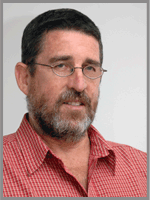
“There are no easy answers for solving America’s energy demands,” says Prof. Asher Tishler, Dean of the Faculty of Management at Tel Aviv University, and his American partner, Chi-Keung Woo of the San Francisco consulting firm Energy and Environmental Economics.

“But a smart formula for easing into the next decade would include a slower evolution towards deregulation of the electricity market, along with an aggressive investment in clean technology,” they say. The two researchers have co-authored a number of economics papers in this field, most recently in the International Journal of Energy Sector Management and Utilities Policy.

Deregulate Slowly, Go Green Quickly

Tishler and Woo recommend that Americans “think greener” by channelling billions of investment dollars into research and development dedicated to creating sustainable and alternative energy solutions during a slow and steady transition to deregulation. “With aggressive R&D, in 10 to 15 years green technology will be a reality,” says Tishler, “and we’ll find that it is not more expensive than traditional sources of energy.”

But what happens to rising electricity costs in the interim? Among the 20 American states that have deregulated utilities, prices for electricity remain higher than the ones that did not. Hang in there, say the researchers.

“Prices in a private market will fluctuate like crazy,” says Prof. Tishler, but “competition over time will reduce this volatility.” He stresses that unlike other traditional commodities, electricity is not easy to control. Rechargeable batteries cannot store electricity when demand is low, no major advances in technology to improve efficiency have been made recently, and labor costs remain high.

Social Costs a Factor

Easing consumers through the deregulation transition may not be easy on their pocketbooks. Tishler and Woo suggest, however, that if consumers are willing to fork out more for their electricity bills in the near future, it will encourage lower usage, thereby conserving power, helping to prevent blackouts, and benefiting the environment.

As the wealth of America’s middle class grows, so does the demand for big screen TVs and all manner of power-hungry electronics and so do greenhouse gas-causing CO2 emissions, taxing the environment further. “Energy consumption is a social issue, not just an economic one,” says Tishler.

An immediate way to cut down on use is by raising power prices even more, and by urging consumers to switch to clean energy. Alternatives such as solar power may be more costly in the short term, but the social benefits, though difficult to calculate, “are huge,” conclude the researchers.

Prof. Asher Tishler holds a Ph.D. in Economics from the University of Pennsylvania, and has been a faculty member at Tel Aviv University since 1976. He was recently appointed dean of the Faculty of Management. Over the last two decades, his research has focused on the defense sector and on optimizing electricity markets.


::American Friends of Tel Aviv University

Karin Kloosterman
Karin Kloostermanhttp://www.greenprophet.com
Karin Kloosterman is an award-winning journalist, innovation strategist, and founder of Green Prophet, one of the Middle East’s pioneering sustainability platforms. She has ranked in the Top 10 of Verizon innovation competitions, participated in NASA-linked challenges, and spoken worldwide on climate, food security, and future resilience. With an IoT technology patent, features in Canada’s National Post, and leadership inside teams building next-generation agricultural and planetary systems — including Mars-farming concepts — Karin operates at the intersection of storytelling, science, and systems change. She doesn’t report on the future – she helps design it. Reach out directly to [email protected]

LEAVE A REPLY

Please enter your comment!
Please enter your name here

TRENDING

The US leaves 66 United Nations organizations to “put America first”

The world needs a reset and to restart well intentioned cooperation projects from start. Because right now the UN and EU projects look like software built on code from the 80s, rickety, patched, slow to adapt, and prone to crashing under the weight of outdated assumptions.

EU Ports Still Power Russia’s Arctic Gas Exports Despite Phase-Out Pledge

The findings suggest that rather than declining, Europe’s reliance on Yamal LNG intensified in 2025. Yamal cargoes accounted for 14.3% of the EU’s total LNG imports, equivalent to roughly one in every seven LNG ships arriving at European terminals.The findings suggest that rather than declining, Europe’s reliance on Yamal LNG intensified in 2025. Yamal cargoes accounted for 14.3% of the EU’s total LNG imports, equivalent to roughly one in every seven LNG ships arriving at European terminals.

Musk’s Saudi Mega-Data Center Signals a Desert Arms Race for AI

For now, Musk’s partnership signals a deepening alignment between Silicon Valley and Riyadh — and a new chapter in the Middle East’s data-powered future. The satellites and robots may come later. The energy footprint, however, is already here.

Medical cannabis Syqe lays off 30% of its workforce

This backing gave Syqe financial muscle and strategic reach—but also raises reputational and strategic risks, given tobacco’s fraught public perception in the health space. Imagine if McDonald’s bought into a regenerative kale farm. The cash infusion could scale production, but people would always wonder if the lettuce was being served with a side of fries. 

Ecomondo 2025: Italy’s Green Expo Powers Global Circular Innovation

Each November, a quiet city on Italy’s Adriatic coast becomes the epicenter of the world’s circular economy conversation. What began in 1997 as a local waste management trade show has grown into Ecomondo, a global forum for environmental innovation, resource regeneration, and ecological transition.

6 Payment Processors With the Fastest Onboarding for SMBs

Get your SMB up and running fast with these 6 payment processors. Compare the quickest onboarding options to start accepting customer payments without delay.

Qatar’s climate hypocrisy rides the London Underground

Qatar remains a master of doublethink—burning gas by the megaton while selling “sustainability” to a world desperate for clean air. Wake up from your slumber people.

How Quality of Hire Shapes Modern Recruitment

A 2024 survey by Deloitte found that 76% of talent leaders now consider long-term retention and workforce contribution among their most important hiring success metrics—far surpassing time-to-fill or cost-per-hire. As the expectations for new hires deepen, companies must also confront the inherent challenges in redefining and accurately measuring hiring quality.

8 Team-Building Exercises to Start the Week Off 

Team building to change the world! The best renewable energy companies are ones that function.

Thank you, LinkedIn — and what your Jobs on the Rise report means for sustainable careers

While “green jobs” aren’t always labeled as such, many of the fastest-growing roles are directly enabling the energy transition, climate resilience, and lower-carbon systems: Number one on their list is Artificial Intelligence engineers. But what does that mean? Vibe coding Claude? 

Somali pirates steal oil tankers

The pirates often stage their heists out of Somalia, a lawless country, with a weak central government that is grappling with a violent Islamist insurgency. Using speedboats that swarm the targets, the machine-gun-toting pirates take control of merchant ships and then hold the vessels, crew and cargo for ransom.

Leopoldo Alejandro Betancourt López Turned Ocean Plastic Into Profitable Sunglasses

Few fashion accessories carry the environmental burden of sunglasses. Most frames are constructed from petroleum-based plastics and acrylic polymers that linger in landfills for centuries, shedding microplastics into soil and waterways long after they've been discarded. Leopoldo Alejandro Betancourt López, president of the Spanish eyewear brand Hawkers, saw this problem differently than most industry executives.

Why Dr. Tony Jacob Sees Texas Business Egos as Warning Signs

Everything's bigger in Texas. Except business egos.  Dr. Tony Jacob figured...

Related Articles

Popular Categories