

How can you set your professional dreams in motion if you have mountains of fear to overcome? For some it may be quitting one’s job to start up the new “green” home business, for others it may be as simple as asking the boss for a raise.
For me, as an environmental journalist dreaming about marine biology and reporting on coral reefs, I didn’t have to overcome my fears, I needed to dive straight into them and walk the walk, or rather, swim the walk – by getting my diver’s certification in order to see my subjects first hand.
Fortunately, I had a loving friend by my side, who reminded me before embarking on my first dive, the words of the Jewish sage, Rabbi Nachman, “The whole world is a very narrow bridge, and the most important thing is not to be afraid!
These are words I would come to know quite well, and take to heart, as I made my first dive.
Underwater, the refraction of light made everything look bigger – especially my fear of drowning. Knees on deep sea-sand, small squares of lead weights holding my body down 18 metres below, in a place where birds never get to fly, I was petrified.
Breathing slowly like my Yoga teacher once taught me was something I was thankful for learning.
Before my first dive off the small island of Koh Tao (Turtle Island) in Thailand, I had tried to prepare myself on the beach – where I compared hypothetical ocean depths to the height of trees, spying through the gap between my forefinger and thumb as a way to estimate how low I would need to go.
Despite the panic swelling up inside of me due to the treacheries of diving we had learned in the classroom, such as decompression sickness, dangerous sea animals, and the possibility of our lungs swelling up like balloons and then bursting, I wanted to be a diver.
As a journalist keen on writing about marine biology and environmental science, I needed that passport to change theory into practice.
How could I speak about the dying coral reefs and polluted marine life if I had never been to any great depths?
But with my head underwater and breathing through the lifeline of my scuba gear, dreams of marine biology were swept away with the current. Once submerged, survival was the only thing I was concerned about.
I clamped my teeth down on the regulator, which supplied a steady flow of oxygen, and reluctantly let the air out of my BCD. My body sank slowly.
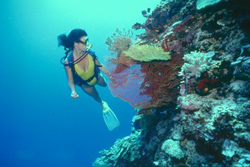
As we descended deeper, I watched our spent air rocket to the surface in the shape of silver-coloured mushrooms. The fish, blasé about their natural talent to breath underwater, appeared to be mocking me. One white fish the size of my hand caressed my arm in support.
The dive instructor then prompted our group of six, one at a time, to flood our masks. In order to earn a license, he told us, one must be able to demonstrate a familiarity with water and the ability to perform certain tasks underwater should we get caught on seaweed, run out of air or lose our masks.
As I watched the others remove their masks without hesitation, my breathing became quick and sharp. Water was already threatening to enter my nose; panic swelled inside my chest. I was going to die.
Biologists call it the “fight or flight reaction” of the sympathetic nervous system – my body’s physiology changing abruptly from a perceived threat. What would I do? The flight option sounded most appealing.
The swaying rope we slid down suddenly seemed inviting. I, on the edge of extreme panic, was separated from the world by a wall of time: when diving one must never swim quickly to the surface, or hold one’s breath. To go up would need to be controlled and with caution.
In that case, better to just get a hold of myself on solid ground, I reason, even if the ground is covered in water. Maybe a million years ago, this sand was actually soil in a forest.
In truth, I ached to join the bubbles on the surface where they broke and where my body would have been free to laugh out loud, cough, and breathe though its nose.
There was no way to speak to tell my instructor I needed time. I faced him, pupils dilated, as he waited for me to release the edges of my mask and let the water well up inside.
Switch breathing to your nose, I told my brain. But the panic had set in and my breathing became too fast to control with Yoga exercises. The instructor grabbed my vest and with two hands held me on the ground. Underwater or above, the ground felt solid. The instructor’s hands were on my heart and an overwhelming rush of love for humanity and nature overtook me.
“The whole world is a very narrow bridge, and the most important thing is not to be afraid!” said Nachman in my head, reminding me as a Jew by choice I have joined a community of people who only through miracles by the hand of God and facing their fears have survived for centuries, against the odds.
Needless to say, I lived.
For the second dive, the sea was rough, but a rainbow arched across the sky. Sinking down into the water, I saw that narrow bridge materialize, in the form of a sunbeam penetrating through the blue.
This time, all the tests my instructor asked me to accomplish underwater were done with ease.
“Our dive club used to volunteer to clean up the reefs,” said my instructor nonchalantly, swimming beside me after the dive. “Rising gas prices and the fact that other dive clubs backed out of the project was the reason why our group stopped helping out. There are a few important marine protection groups here on the island you should check out,” he continued.
“And,” he added, “How about a fun dive at 30 meters tomorrow?”
What’s that? A dive for fun? He’s treating me like a diver, I said to myself as I lugged my tank towards the boat, energized. I was now a diver, having faced my fears and found my faith.