
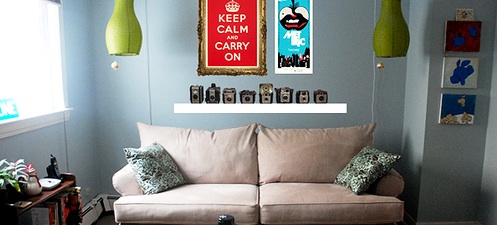

We’ve already had a green kitchen party, we’ve learned about ways to conserve water while greening the old bathroom; we’ve even talked about ways to green your bedroom (hey, you know what we mean). Today we’re moving over to the living room, with a focus on energy conservation.
Roughly two-thirds of our annual energy budget gets pumped into space and water heating in the home. Winter heating emits greenhouse gases.
The good news is that there are ways to heat the living room without being a burden on the earth: Turn down the thermostat, put on a sweater, and cuddle up on the couch under a big blanket are great ways to cut down on heating use.
Draft-proofing sounds like a boring activity for a weekend project, but it works to keep the heat in your living space, especially in Israel where houses are so drafty. To keep away pollutants from unflued heaters, and to avoid mould and mildew build-up, open your living room windows only for a flash – a few minutes several times a day.
While old wood-burning fireplaces are a romantic setting for the living room, the mood might be ruined if you knew that fireplaces give off heat worth 10 percent of the energy burned – the rest is swept up the chimney.
 Exchange the fireplace with a modern biomass-burning pellet stove – a tall order in this neck of the woods, perhaps. But it is an efficient heating option, produces very little waste and uses cheap fuel.
At the end of the day, Mother Nature knows best. Known as “passive” techniques, install larger windows and skylights, and put a thermal mass like a concrete slab close to the windows. All will aid your home (and living room) to absorb solar heat.
If you are building a new home, or extension and have the luxury to do so, ask the architect to design it so the longest walls span the east and west directions. This will allow the sun’s rays to bathe your living room; and as the angle of the sun changes in the summer, it will keep the rays away.
Vampires, whether you know it or not, can be living in your living room. Also known as “wall warts” they are living on your electrical cords and sucking your electricity dry even when not in use.
The solution? Unplug your appliances and devices when not in use or buy a power strip with a switch and turn the living room “off” when it is not in use.
Full spectrum, natural daylight is the cheapest, greenest and best for our bodies. Keeping the living room lit with natural light is a good way to keep the electrical bills low and stave off seasonal affective disorder (SAD) brought on by shorter and colder winter days.
If home remodeling isn’t in your future plans, you can easily purchase compact florescent bulbs (CFLs) – the ice-cream coned shaped light bulbs that come in many shapes and sizes. They cost more than the traditional incandescent bulb, but use a quarter of the much energy and last much longer – usually around 10,000 hours. After 500 hours of use, a CFL already pays for its higher price.
And the newest wave in green lighting are LEDs, or light emitting diodes. They are energy efficient and extremely long-lasting light bulbs. Using about 80-90% less energy than a traditional bulb, LEDs will last about 100,000 hours.
Little changes in our homes are a big deal: According to the International Energy Agency (IEA), if the world switched to efficient lighting systems we could decrease the world’s electricity bill by about one-tenth.
Paul Waide, an analyst with the IEA says, “19% of global electricity generation is taken for lighting – that’s more than is produced by hydro or nuclear stations, and about the same that’s produced from natural gas.”
A great way to green your lighting is to buy green power. Ask your electric utility company if you can buy into a green power option on your monthly bill. It might mean paying a few more dollars a month to pay for energy from renewable sources such as wind, solar, or biogas. We haven’t heard about this idea in Israel, yet, but it is something to keep in mind.
The more natural you can keep your living room – the more calm and serene you will feel in that room.
Organic wood products, and more recently bamboo (it’s lauded as one of the most sustainable materials ever) have become choice furniture materials for the living room. Bamboo can be used for chairs, sofas, fabric coverings and even flooring.
Bamboo grows as fast as 18 inches in a day, and can be harvested in within five years, in contrast to 50 to 100 years for hardwood. Bamboo also requires very little fertilizer or pesticides – all great pluses for those concerned about the environment inside and outside the home. (We’ve talked about Israeli bamboo toys here.)
When choosing furniture it’s also important to be aware of products made with formaldehyde. In 2004 the World Health Organization upgraded formaldehyde from a probable carcinogen to a known one. It is a chemical in many household products, in the form of glues, plywood and furniture foam.
“It’s that new-car smell,” says Monica Gilchrist of the Green Building Resource Center in California. “It’s the smell of a new carpet. It’s that new-desk smell – you bring in a new desk, and the panels are put together with a glue that contains formaldehyde. Off-gassing is the continual emission of the chemicals from the product. And these chemicals are found in blood levels over time.”
Going for sustainable, natural materials in the living room can certainly help de-stress modern people on the constant search for tranquility.
“[Bamboo products] falls into that umbrella of health and well-being,” said Leslie Gillock, a VP for Springs Industries, a company that which produces bamboo pillows and blankets.
Always keep in mind Fen Shui – a Chinese practice that recognizes your living room as your private sanctuary and the heart of the family home. Guard this private place from too many distractions such as clutter.
Use soft and round sofas and chairs; place pictures of family and family on the east wall to enhance health, and dispel negative energy caused by televisions by placing them behind cabinet doors or behind plants.
 But whether it’s bamboo furniture, Feng Shui or your grandmother’s hand-knitted afghan hanging on the arm of the couch, be sure to fill your living room with homey and comfortable objects that make you feel like living and becoming more green.
Read more Green Guides:
Green Prophets Start at Home: The Bedroom
Green Prophets Start at Home: The Kitchen
Green Prophets Start at Home: The Living Room
Slipper Rocking Chair
(Image credit greenapplebrigade)



cherry electric fireplace…
Tyler Morning Telegraph- There stood a log cabin , built who knows how many years earlier. Inside hunters would be stacked like cord wood in bunk beds….