

Energy, we all need it for practically everything we do. With global warming accelerating and fossil fuels expected to run out in decades, the hunt is on for alternative energy sources.
Professor Dan Zaslavsky from the Technion in Haifa has come up with a solution (expanding on the work of Dr. Phillip Carlson) and it’s called the Energy Tower – which will not only reduce the costs of energy from our pockets but from our planet as well.
“It’s a radically simple idea. We could easily produce between 15 to 20 times the total electricity the world uses today,” he says.
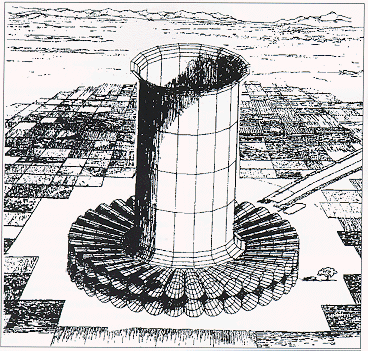
Standing 1,000 yards tall and 400 across, Zaslavsky’s tower takes advantage of convection, the natural principle that warm air rises and cool air sinks. Placed in a hot dry place, with access to water, the tower sucks in hot air traveling above it and water lining the tower cools the hot air as it gets pulled down.
(Cool air picks up speed as it goes down).
When this air reaches the bottom of the tower it is traveling at such a speed that it can power turbines at the tower’s base and create electricity. The water that comes out is cool and humid.
This design isn’t only capable of creating electricity it can do much more. With simple alterations Zaslavsky explains:
He tells Green Prophet: “We can produce cheap desalinated water, we can irrigate the desert, we can produce bio-fuel, we can boost aquaculture.”
It’s not surprising that the country of Israel, which made its deserts bloom, developed this idea.
Estimates predict that Zaslavsky’s looming tower could create electricity at 2.5 cents per kilowatt-hour, less than a third of the cost of electricity in Israel today.
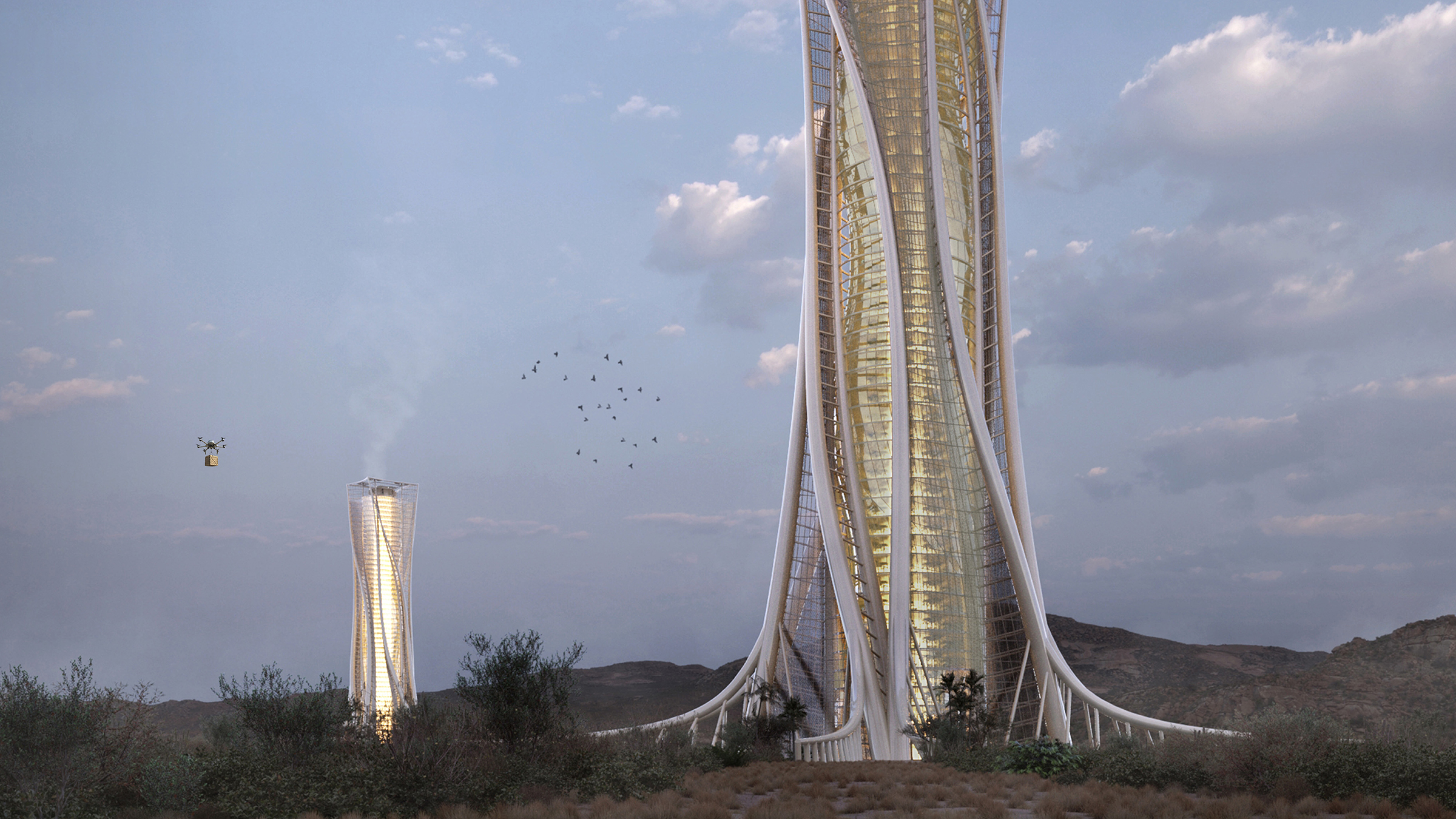
We could put these towers in driest regions of the world. Sure it would mean figuring out how to get the water there, but because the process desalinates we don’t have to waste precious drinking water and the towers emit humid air instead of greenhouse gasses. In fact, it could drastically transform barren deserts to habitable places.
Cynical reports suggest that these towers are not practical because: “The technology requires a hot and arid climate, and at the same time access to large amounts of water… Most of these regions are remote and thinly populated, and would require power to be transported over long distances to where it is needed.”
They are overseeing the fact that the Sharav Sluice Energy Tower would make these places habitable
Green Prophet related:



[…] Jump up^ Dan Zaslavsky’s Tower That Vacuums Up Greenhouse Gases | Green Prophet […]
I can only imagine that budgeting and small ‘c’ conservatism and vested interests of big oil that have so far prevented this scheme going ahead. Even the petro-sheikhs have an interest in this technology as it would enable them to irrigate their coastal strip for “small” holders and feed their bolshy hyperinflating young men cheaply instead of coping with the religious mania of unemployment.
The cost about 2000 was $1800 a unit/ a tower with associated machinery and water channeling, which defrayed over half a decade building time is small change in national energy costs and sales even in a small country like Israel. As each section of construction finished the teams could move to the next site and the whole plan could provide work for two or three decades in Israel and comparably in California or Australia, Spain India and Chile.
[…] Institute of Technology의 Dan Zaslavsky 교수와 Dr. Rami Guetta는 1975년 Phillip R. Carlson이 특허를 낸 아이디어의 구현에 […]
[…] Dan Zaslavsky and Dr. Rami Guetta from Technion-Israel Institute of Technology are trying to develop an idea […]
[…] Dan Zaslavsky and Dr. Rami Guetta from Technion-Israel Institute of Technology are trying to develop an idea […]
it apears that these guys just got permission to rezone a large amount of land to build two of these things in AZ
Really??? Tell us more. In Arizona, US?
Is this Professor, Dan Zaslavsky, related to or acquainted with another Technion Professor by the same or similar name? I knew a Dan Zaslavsky (spelling?), who was a PHD candidate at Iowa State University in Ames, Iowa, circa 1958/1961. The Dan Z I knew was most interested in soil and water conservation, studying a meld of Civil and Agricultural Engineering. His wife was Aviva, and they had 2 children. My wife, Barbara Campbell, and I would be very happy if my Dan Zaslavsky was known or related to the young Professor who has created the Energy Tower. Thank you for any information you may have. Charles Campbell
I have met him and he is the one from the Technion.
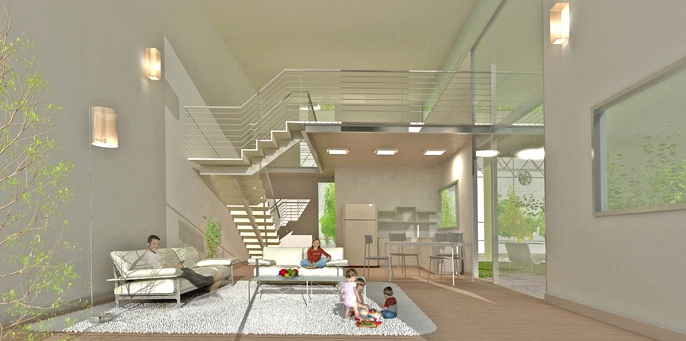
If you altered the structure of the tower so as to have offices and apartments on its outside walls it would defray the cost of the tower, make it more attractive for use in populated areas and provide an additional source of income to the owners. With the tower providing water, power, housing, and workplaces this may be the shape of the city of the future. Combine it with some of the vertical farming concepts and you could have an entirely self sustaining city.
For starters one would go up 15 miles North of Eilat at Timna from where its water & power would develop the Arava region . Ditto a trio of Jordanian towers 3 miles and inland South of Aqaba to pipe water to Jordan’s cities. Other good sites are say ten miles outside each of Australia’s coastal cities along the Chilean and Peruvian coasts and Namibia and S. Africa’s “Skeleton[West] coast – and the coasts ofthe Gulf of California to sell power and waterto LAand Arizona! The beauty of these new now desert areasis that with a bit ofcommon sense planning the tower with associated industry and town could be kept at a distance from each other.
For bonus these towers would see over 100 000 cubic kilometers of air through them each day and with a bit of chemistry could extract CO2 and produce ammonia as a substitute for oil or pure hydrogen fuels. As ammonia is NH4 and burns without any carbon releasing only Oxygen, water and Nitrogen it might be the answer to the CO2 problem.
I found the E.T. idea fascinating but I am a bit dissappointed and intrigued to see that the project has not been started after 25 years. If the project is feasible I cannot believe there is no money to put it into practice.
Juan
do any exist today and how long would one take to be constructed
I am on the debate team at my high school and i am running energy towers as my affirmative case. i think energy towers are an amazing idea and this site is very helpful for finding information.
How much will this project cost and how many are going to be put up.
Can I combine Energy Tower with Solar Chimney in a simple way exploiting chimney and reversed chimney effects?
Nice comment on the comment, Jack! You give me hope.
TZ, thanks for your comment!
I do not think that anyone wants ANY power plant in their backyard. The beauty of this Energy Tower is that it has the potential of converting entire inhabitable regions, in an environmentally friendly way, into a place that CAN be habitable.
The problems you raise can be dealt with, whether by placing trees around the tower’s base to break up the wind created, or placing nets so that birds do not fall victim to progress.
Did you know that 90% of the Earth’s population lives in 10% of the Earth’s landmass? Maybe that can be changed without harming our planet. Here is a possible solution…
Where would you propose such a thing would “live?” It looks massive…I wouldn’t want one in my back yard that’s for sure. And would it create more wind in the neighborhood? What about birds? Won’t they get sucked down into that giant monster. Seems preposterous to me…