
Knafo Klimor Architects Design True "Green House" Living For China

knafo klimor israel china architects eco-apartment photoApartments for China, outfitted with individual greenhouses. We’d live in one of these eco-abodes.

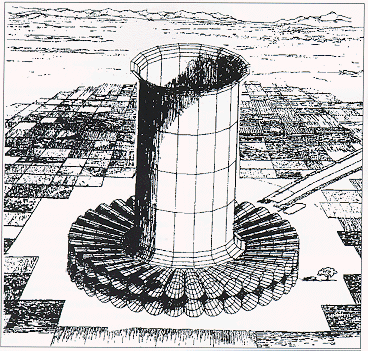
Outdoor vegetable gardens are nice, but as it turns out, they are so 2007. Now Technion Institute researchers Tagit Klimor and David Knafo have developed a design for high-rise apartments that will have their own self-sustaining greenhouses.

The greenhouse spaces will enable families to grow produce for their own consumption, with enough left over to generate additional income.

Each apartment will have a trellised greenhouse space measuring approximately 100 feet. These areas would be climate controlled and employ a system that uses soilless growing media (such as coconut, peat and other organic mixtures), a liquid fertilization system, and an advanced drip irrigation system.

The irrigation system will use recycled water from the apartments and rainwater collected from the rooftop. The building will also feature solar heating and cooling systems and a geothermal system.

For their design, Klimor and Knafo won the Second Annual Living Steel International Architecture Competition for Sustainable Design.

“The project constitutes a revolution in the existing social and urban order,” said Knafo. “Among its advantages are significant savings in energy, providing fresh, pesticide-free organic food, freeing agricultural land for forests, which contribute to the environment, preventing soil pollution by pesticides, and intelligent use of recycled water for irrigation.”

The first implementation of this design will be carried out in Wuhan, China, and according to Chinese officials, more real estate of this type are expected to follow.

If this design becomes popular, we’re interested in how it will affect neighbor-to-neighbor dynamics. “Why do their carrots always look bigger than ours?” could become a new refrain in the eternal struggle to keep up with the Joneses.

:: See movie on their website Knafo Klimor Architects.

::Knafo Klimor Architects

3 COMMENTS
  1. Dear sir

    the information about green house are very intresting and i hope you are being secces more on your feild.i also have intrest to know about green house,if you have opportuenity to send me some information about green house it will be your kind me.

    best regard

  2. wow, would it be possible to live in one of these? would the air be to sticky and moist? if not, they need to start making regular houses into greenhouses. i have plants in my windows and it feels like such a waste to have a flat boring wall when i could have plants all around. i’d have sand on my floor so i could always feel like i’m on a beach.

LEAVE A REPLY

Please enter your comment!
Please enter your name here

TRENDING

Earth building with Dead Sea salt bricks

Researchers develop a brick made largely from recycled Dead Sea salt—offering a potential alternative to carbon-intensive cement.

Farm To Table Israel Connects People To The Land

Farm To Table Israel is transforming the traditional dining experience into a hands-on journey.

Remilk makes cloned milk so cows don’t need to suffer and it’s hormone-free

This week, Israel’s precision-fermentation milk from Remilk is finally appearing on supermarket shelves. Staff members have been posting photos in Hebrew, smiling, tasting, and clearly enjoying the moment — not because it’s science fiction, but because it tastes like the real thing.

China is one step closer to making artificial sun

Nuclear fusion is often described as the holy grail of clean energy: a process that could one day provide abundant power without carbon emissions or long-lived radioactive waste. It has so much promise, but it's difficult. This article on fusion explains why. But turning fusion into a practical energy source depends on solving a set of extremely difficult physics problems. One of the most important is how to keep plasma — a super-hot, electrically charged gas — dense, stable, and confined long enough to produce useful energy.

An Army of Healers Wins the 2025 IIE Goldberg Prize for Peace in the Middle East

In a region more accustomed to headlines of loss than of listening, the Institute of International Education (IIE) has chosen to honor something quietly radical: healing. The 2025 Victor J. Goldberg Prize for Peace in the Middle East has been awarded to Nitsan Joy Gordon and Jawdat Lajon Kasab, the co-founders of the Army of Healers, for building spaces where Israelis and Palestinians — Jews, Muslims, Christians, Druze, and Bedouins — can grieve, speak, and rebuild trust together.

Qatar’s climate hypocrisy rides the London Underground

Qatar remains a master of doublethink—burning gas by the megaton while selling “sustainability” to a world desperate for clean air. Wake up from your slumber people.

How Quality of Hire Shapes Modern Recruitment

A 2024 survey by Deloitte found that 76% of talent leaders now consider long-term retention and workforce contribution among their most important hiring success metrics—far surpassing time-to-fill or cost-per-hire. As the expectations for new hires deepen, companies must also confront the inherent challenges in redefining and accurately measuring hiring quality.

8 Team-Building Exercises to Start the Week Off 

Team building to change the world! The best renewable energy companies are ones that function.

Thank you, LinkedIn — and what your Jobs on the Rise report means for sustainable careers

While “green jobs” aren’t always labeled as such, many of the fastest-growing roles are directly enabling the energy transition, climate resilience, and lower-carbon systems: Number one on their list is Artificial Intelligence engineers. But what does that mean? Vibe coding Claude? 

Somali pirates steal oil tankers

The pirates often stage their heists out of Somalia, a lawless country, with a weak central government that is grappling with a violent Islamist insurgency. Using speedboats that swarm the targets, the machine-gun-toting pirates take control of merchant ships and then hold the vessels, crew and cargo for ransom.

Leopoldo Alejandro Betancourt López Turned Ocean Plastic Into Profitable Sunglasses

Few fashion accessories carry the environmental burden of sunglasses. Most frames are constructed from petroleum-based plastics and acrylic polymers that linger in landfills for centuries, shedding microplastics into soil and waterways long after they've been discarded. Leopoldo Alejandro Betancourt López, president of the Spanish eyewear brand Hawkers, saw this problem differently than most industry executives.

Why Dr. Tony Jacob Sees Texas Business Egos as Warning Signs

Everything's bigger in Texas. Except business egos.  Dr. Tony Jacob figured...

Israel and America Sign Renewable Energy Cooperation Deal

Other announcements made at the conference include the Timna Renewable Energy Park, which will be a center for R&D, and the AORA Solar Thermal Module at Kibbutz Samar, the world's first commercial hybrid solar gas-turbine power plant that is already nearing completion. Solel Solar Systems announced it was beginning construction of a 50 MW solar field in Lebrija, Spain, and Brightsource Energy made a pre-conference announcement that it had inked the world's largest solar deal to date with Southern California Edison (SCE).

Related Articles

Popular Categories